Part of our Artificial Intelligence in Business series — a complete executive guide to putting AI to work across your organization.
The Workforce Is Expanding Beyond Humans
For centuries, businesses have relied on people to perform work. Every organization was built around a simple assumption: if you wanted more output, you needed more employees.
Growth required hiring. Scaling required larger teams. Operations depended on human labor. Technology improved productivity, but software remained a tool. Humans still performed the work.
Artificial Intelligence is changing that assumption.
A new workforce layer is emerging inside organizations around the world — one composed of digital employees.
These AI-powered workers are not simply chatbots, automation scripts, or productivity tools. They are increasingly capable of performing tasks, managing workflows, making decisions, coordinating systems, and executing responsibilities that were traditionally assigned to human employees.
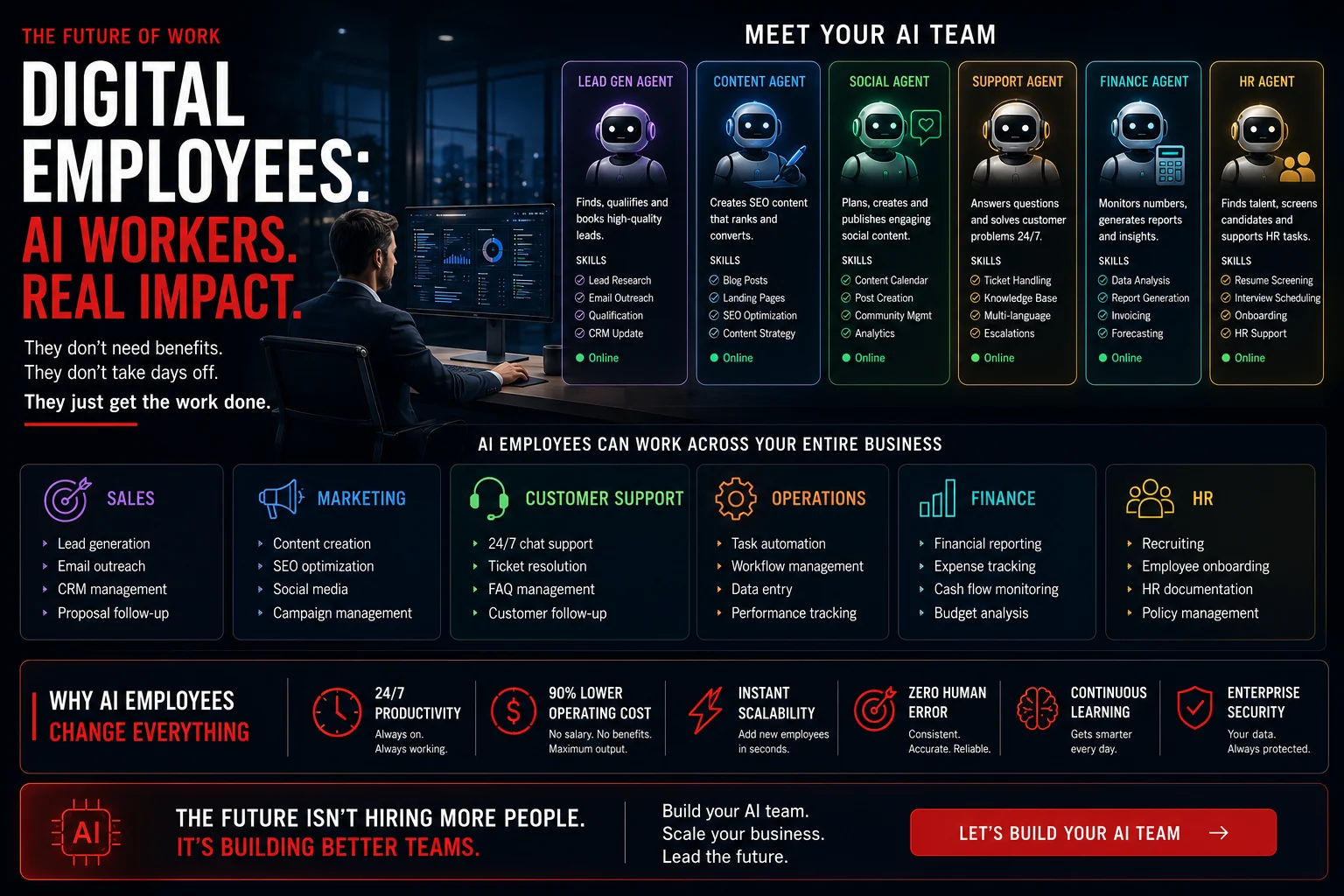
Sales teams are deploying AI sales representatives. Marketing departments are building AI content teams. Customer service organizations are onboarding AI support specialists. Finance departments are experimenting with AI analysts. Recruiting teams are deploying AI talent coordinators.
The workforce of the future will not consist solely of humans. It will consist of humans and digital employees working together.
The organizations that learn how to manage this hybrid workforce effectively may gain one of the largest competitive advantages of the next decade.
What Is a Digital Employee?
A digital employee is an AI-powered operational worker assigned a specific role, responsibility, and set of objectives within an organization.
Technically, a digital employee is an AI agent given a persistent role, memory, and accountability inside your org chart — the difference is organizational, not just technical.
Unlike traditional software, which waits for human instructions, digital employees can actively participate in business processes. They can complete tasks, access systems, analyze information, execute workflows, collaborate with humans, work with other AI agents, report outcomes, and improve performance over time.
The Evolution of Business Technology
The journey toward digital employees has occurred in stages: Software → Automation → AI Assistant → AI Agent → Digital Employee.
Each stage increased autonomy. Software provided tools. Automation executed predefined workflows. AI assistants answered questions and generated content. AI agents performed actions and completed tasks. And digital employees own responsibilities and contribute operational value.
Why the Workforce Is Changing
Several forces are accelerating adoption: labor shortages, rising operational costs, increased competition, rapid advances in AI, demand for faster execution, and growing complexity of business operations.
Organizations need a way to increase output without increasing headcount at the same rate. Digital employees provide that leverage.
Traditional software improves productivity. Employees create outcomes. Digital employees combine both functions. They are tools that work. That shift changes how organizations think about staffing, productivity, and scale.
AI Employee vs Traditional Automation
Many businesses mistakenly believe digital employees are simply another form of automation. They are not.
Traditional automation follows predefined rules, such as sending emails after form submissions, generating invoices, triggering notifications, or moving records between systems. Automation is predictable because every outcome is defined in advance. Its strength is consistency. Its limitation is flexibility.
Digital employees operate differently. They are goal-oriented, context-aware, adaptive, and decision-capable. Instead of following fixed instructions, they work toward objectives.
Consider a simple example. With traditional automation, a lead submits a form, the system sends an email, and the workflow ends. With a digital employee, a lead submits a form and the digital employee researches the company, enriches contact data, evaluates lead quality, scores opportunity value, updates the CRM, schedules a meeting, notifies the sales team, and generates talking points.
The difference is profound. Automation executes steps. Digital employees execute responsibilities.
AI Employee vs Human Employee
One of the most important questions organizations ask is whether digital employees will replace human workers. The answer is more nuanced.
Both human and digital employees can have roles, responsibilities, objectives, KPIs, workflows, and performance expectations. Both contribute to organizational outcomes.
Humans remain superior in areas such as creativity, empathy, relationships, strategic judgment, and leadership. Humans generate original ideas, understand emotions, build trust and influence, navigate ambiguity, and inspire teams.
Digital employees excel in different areas. They deliver speed, scale, consistency, availability, memory, and cost efficiency. Tasks execute almost instantly, multiple tasks occur simultaneously, processes remain standardized, operations continue around the clock, information is retained indefinitely, and output scales without proportional hiring.
The future is not human versus AI. The future is human and AI. Organizations will increasingly combine human creativity, leadership, and judgment with AI execution, analysis, and coordination. The most successful businesses will build hybrid workforces where each contributes according to its strengths.
Roles Digital Employees Can Fill
The potential applications for digital employees span nearly every department.
AI Sales Employees
Sales teams spend enormous amounts of time on repetitive activities. Digital sales employees can support prospecting, lead qualification, CRM management, follow-up, and pipeline monitoring. Human sales professionals focus on relationships and closing. Digital employees handle the operational workload.
AI Marketing Employees
Marketing departments are rapidly becoming AI-powered. Digital marketing employees can support content creation, GEO, SEO, campaign management, and reporting. Marketing teams gain dramatically greater output without proportional growth in staffing.
AI Customer Support Employees
Support organizations increasingly deploy digital employees to manage customer interactions. Responsibilities include ticket resolution, knowledge retrieval, escalation, and customer onboarding. This enables faster support while improving consistency.
AI Operations Employees
Operations departments often manage repetitive coordination work. Digital employees can support documentation, scheduling, workflow management, and project coordination. Operations become more efficient and scalable.
AI Recruiting Employees
Talent acquisition is increasingly AI-assisted. Digital recruiting employees can support candidate sourcing, screening, scheduling, and onboarding. Recruiters gain more time for relationship-building and strategic talent evaluation.
AI Finance Employees
Finance departments are particularly well suited for digital employees. Responsibilities include reporting, budget monitoring, forecasting, invoice processing, and expense analysis. Finance teams gain faster insights and improved operational efficiency.
Managing Digital Employees
As organizations adopt digital employees, management practices must evolve. Future managers will supervise both humans and AI workers.
Every digital employee should have a clearly defined role, because ambiguity creates inefficiency. Digital employees require measurable KPIs, such as leads qualified, tickets resolved, reports generated, or revenue influenced. Digital workers need appropriate access permissions, because too little access limits value while too much access creates risk. Organizations must continuously monitor performance, and digital employees improve through iteration and refinement. Above all, humans remain accountable for outcomes. The best systems combine autonomy with supervision.
The Economics of Digital Employees
This may be one of the strongest business cases for AI adoption.
Human employees typically require salary, benefits, recruitment, training, office space, equipment, management, and turnover costs. These expenses increase as organizations grow.
Digital employees typically require software subscriptions, infrastructure, implementation, monitoring, and optimization. While costs exist, scalability is fundamentally different.
A single digital employee can often support workloads that previously required multiple people. The result is not necessarily workforce reduction. The result is greater leverage. Organizations increasingly evaluate AI investments based on time savings, revenue growth, operational efficiency, customer satisfaction, and reduced costs. Many deployments achieve positive returns far faster than traditional technology investments. And when additional capacity is required, organizations can deploy more digital employees rapidly, because scaling no longer requires months of recruiting and onboarding.
Building Your First Digital Workforce
Most organizations should begin gradually.
Start by identifying repetitive work that consumes significant time. Map opportunities where AI can create value. Deploy AI agents on focused use cases. Create digital employees by assigning responsibilities and objectives. Integrate systems by connecting AI to existing workflows. Monitor performance to track outcomes and improvements. And scale by expanding successful deployments across departments.
The digital workforce maturity model runs from Manual Work to Automation to AI Agents to Digital Employees to Digital Workforce. Organizations that follow this progression typically achieve better outcomes than those attempting large-scale transformation immediately.
Risks and Governance
Digital employees introduce significant opportunities but also new responsibilities.
AI systems can generate incorrect information, so verification remains important. Access controls must be carefully managed. Organizations must align AI operations with regulations. AI workers should only access information necessary for their role. Sensitive information requires protection. Humans remain responsible for decisions and outcomes. And critical actions should include oversight mechanisms.
The future of AI is not unrestricted autonomy. It is governed autonomy.
The Future of Digital Employees
The current generation of digital employees is only the beginning. Future systems will become significantly more capable.
As digital employees multiply across departments, the organization itself becomes an autonomous organization — a small human team directing a large, coordinated AI workforce.
AI workers will maintain long-term organizational context through persistent memory. Organizations will increasingly assign identities and responsibilities to named AI employees. Digital employees will become highly specialized. Multiple AI workers will coordinate complex projects through inter-agent collaboration. Routine work will require minimal human intervention. And businesses will manage digital employees through dedicated workforce management platforms, overseeing human employees, contractors, vendors, and digital employees through a single operating platform.
The distinction between software and workforce will continue to blur.
Conclusion
Digital employees represent one of the most important developments in the future of work. They are transforming AI from a productivity tool into an operational workforce layer capable of supporting nearly every business function.
Sales, marketing, customer support, operations, recruiting, and finance are already experiencing this shift. Organizations that successfully integrate digital employees will gain advantages in speed, scalability, efficiency, and resilience.
The future workforce will not consist solely of humans. It will consist of humans and AI working together.
The question is no longer whether digital employees will become part of business operations. The question is how quickly organizations learn to build, manage, and scale their digital workforce.