Part of our Artificial Intelligence in Business series — a complete executive guide to putting AI to work across your organization.
Businesses Are Entering a New Era of Work
For decades, software has helped businesses store information, organize processes, and automate repetitive tasks. Yet software has always depended on humans to decide what happens next.
Artificial Intelligence is changing that.
The latest generation of AI systems is evolving from passive tools into active participants in business operations. These systems, known as AI Agents, can understand objectives, make decisions, interact with software, and complete tasks across multiple systems with minimal human intervention.
Unlike traditional automation, which follows predefined rules, AI agents adapt to changing circumstances, collaborate with other agents, and continuously improve through feedback.
The result is a fundamental shift in how organizations operate.
Businesses are beginning to deploy digital workforces capable of supporting sales, marketing, customer service, finance, operations, and administrative functions around the clock.
The companies that learn how to integrate AI agents today will gain a significant competitive advantage in speed, efficiency, scalability, and decision-making.
What Is an AI Agent?
An AI agent is an intelligent software system capable of perceiving information, reasoning about objectives, taking actions, and learning from outcomes.
Unlike traditional software, which follows fixed instructions, or chatbots, which primarily answer questions, AI agents are designed to achieve goals.
A modern AI agent can:
- Access business systems and databases
- Retrieve and analyze information
- Execute workflows
- Make recommendations
- Trigger actions across applications
- Collaborate with other agents
- Escalate complex decisions to humans
Think of an AI agent as a digital employee rather than a software tool.
Its purpose is not simply to answer questions.
Its purpose is to accomplish outcomes.
The Evolution of Business Software
The progression is clear:
Software → Automation → AI Assistant → AI Agent → Digital Employee
Each stage increases autonomy, intelligence, and business impact.
Traditional software helped humans work.
AI agents increasingly work alongside humans.
Digital employees will eventually work for humans.
AI Assistant vs AI Agent
Many organizations use the terms interchangeably, but the distinction is critical.
AI Assistants
AI assistants are reactive. They wait for instructions. They answer questions. They generate content. They require ongoing human direction.
Examples include asking ChatGPT to write an email or summarize a document.
AI Agents
AI agents are proactive. They understand objectives. They plan actions. They use tools. They execute workflows. They monitor results. They learn and improve.
An AI assistant is like a consultant providing recommendations.
An AI agent is like an employee carrying out the work.
For example, an assistant might generate a sales email. An agent might identify prospects, generate personalized outreach, send emails, update the CRM, schedule follow-ups, and report results automatically.
The difference is not intelligence. The difference is execution.
How AI Agents Work
Although implementations vary, most AI agents follow a similar operating cycle.
The most capable agents increasingly draw on multimodal AI to interpret not just text but images, audio, and video as they work — perceiving the full context of a task the way a person would.
1. Observe
The agent gathers information from available systems, databases, applications, APIs, documents, and conversations. Examples include CRM records, website analytics, emails, support tickets, inventory systems, and financial data.
2. Analyze
The agent evaluates context and determines what information matters. It identifies opportunities, risks, anomalies, and priorities.
3. Decide
Using reasoning models and business rules, the agent determines the most appropriate next action.
4. Execute
The agent takes action using available tools and integrations. This may include sending emails, updating CRM records, creating reports, launching campaigns, scheduling meetings, and assigning tasks.
5. Learn
Results are monitored and used to improve future decisions. This creates a continuous feedback loop.
Observe → Analyze → Decide → Execute → Learn
The process never stops. The more data and feedback available, the more effective the agent becomes.
The Rise of Multi-Agent Systems
The future of business automation is not a single super-agent. It is a network of specialized agents working together.
When these coordinated agent networks take over a critical mass of a company's operations, the organization itself begins to change shape — the emerging model is the autonomous organization, where a small human team directs a large digital workforce.
Businesses already operate through departments with specialized responsibilities. AI systems are beginning to mirror this structure.
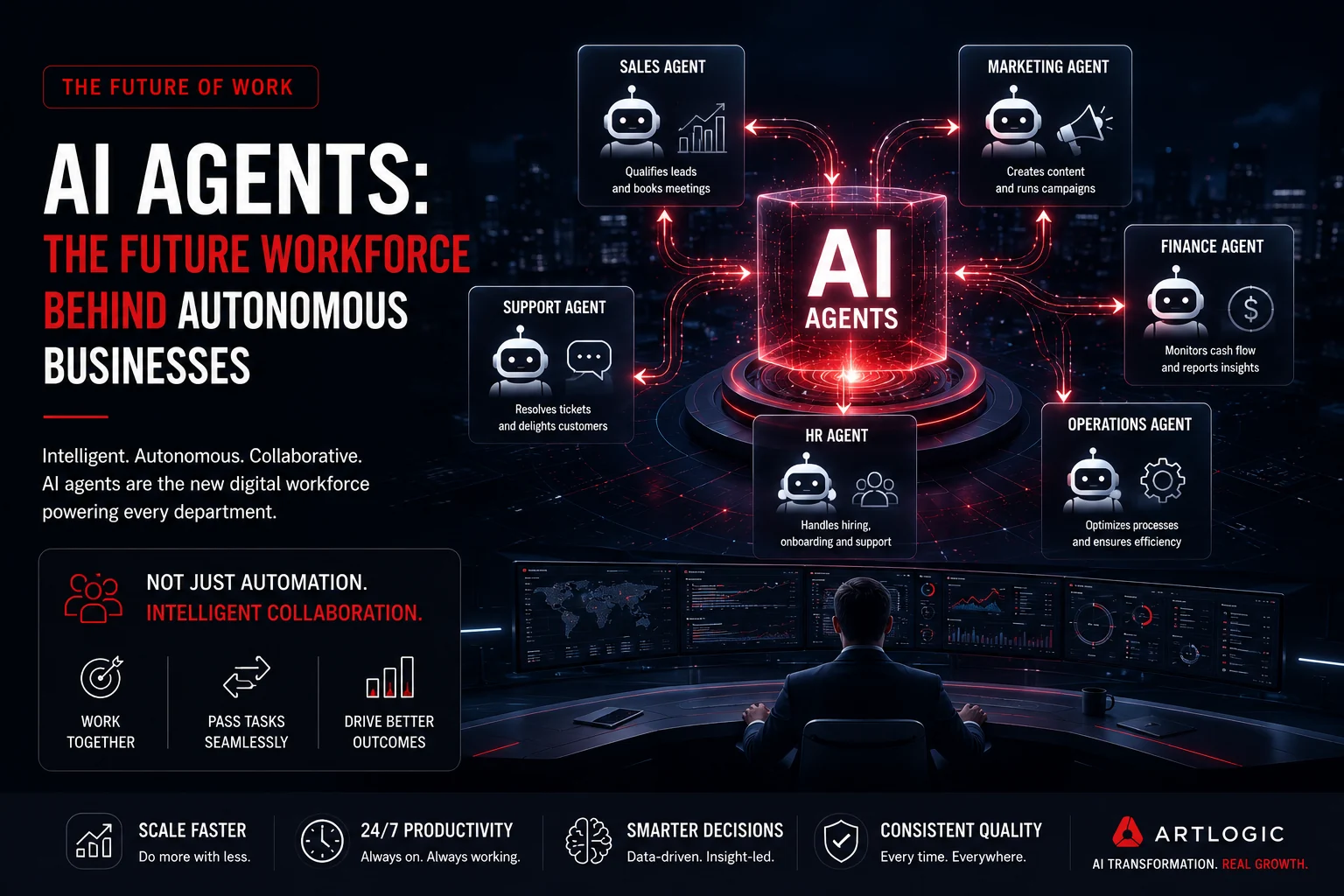
A marketing agent creates campaigns. A sales agent qualifies leads. A finance agent validates budgets. A customer service agent resolves issues. An operations agent coordinates workflows. An HR agent manages recruiting and onboarding.
Together, they form a coordinated digital workforce.
This approach is known as a Multi-Agent System.
Rather than relying on one general-purpose AI, organizations deploy multiple agents with specific expertise that collaborate toward shared business objectives.
This structure improves accuracy, scalability, security, reliability, and performance.
The future belongs to organizations capable of orchestrating dozens — or even hundreds — of specialized AI agents.
AI Agents Across Every Department
Marketing
Marketing teams are among the earliest adopters of AI agents. Marketing agents can create content, manage editorial calendars, optimize SEO strategies, improve GEO visibility, publish social media content, monitor campaign performance, and generate reports.
Rather than replacing marketers, these agents remove repetitive work and increase productivity.
Sales
Sales agents can prospect leads, qualify opportunities, update CRM systems, send personalized outreach, schedule meetings, generate proposals, and follow up automatically.
Organizations are already deploying AI SDRs that work continuously around the clock.
Customer Support
Support agents can triage tickets, answer questions, search knowledge bases, escalate complex cases, onboard customers, and gather feedback.
The result is faster response times and improved customer experiences.
Operations
Operations agents can coordinate projects, manage workflows, track deadlines, generate documentation, schedule resources, and monitor business performance.
Finance
Finance agents can process invoices, monitor expenses, generate forecasts, prepare reports, identify anomalies, and improve financial visibility.
Human Resources
HR agents can screen candidates, schedule interviews, support onboarding, answer policy questions, manage documentation, and improve recruiting efficiency.
Every department will eventually have dedicated AI support. Many already do.
Digital Employees Are Becoming Reality
For many organizations, AI agents are evolving into digital employees.
This is the foundation of the digital employee: a persistent, named agent with a defined role, memory, permissions, and performance metrics — an AI worker that belongs on the org chart, not just in the tech stack.
Businesses will soon manage four categories of workforce resources: human employees, contractors, vendors, and digital employees.
Digital employees will have many characteristics traditionally associated with human workers. They will possess defined responsibilities, assigned roles, memory and context, access permissions, performance metrics, and reporting structures.
Organizations may soon refer to digital employees the same way they refer to team members today, with roles such as Marketing Content Agent, Sales Development Agent, Customer Success Agent, Finance Reporting Agent, and Recruitment Agent.
The distinction between software and workforce will continue to blur.
What matters is not whether the worker is human or digital. What matters is the outcome they produce.
The Benefits of AI Agents
24/7 Availability
AI agents never sleep, take vacations, or wait for office hours. They provide continuous operational support.
Lower Operating Costs
Organizations can scale capabilities without proportional increases in headcount.
Faster Execution
Tasks that once required hours can often be completed in seconds.
Better Consistency
Processes are executed according to defined standards every time.
Infinite Scalability
Additional agents can be deployed almost instantly.
Better Decision Support
AI agents continuously monitor data and identify opportunities or problems before humans notice them.
Combined, these advantages create significant productivity gains.
Risks, Governance, and Responsible Deployment
AI agents introduce powerful capabilities, but they must operate within clearly defined boundaries.
Successful organizations establish governance frameworks that include human oversight, security controls, audit trails, approval workflows, access management, and compliance monitoring.
Critical decisions should remain under human supervision. Agents should only access information required for their role. Every action should be recorded and traceable. High-impact actions should require authorization. Permissions should be carefully controlled and monitored. And organizations must ensure AI operations comply with legal and regulatory requirements.
The future is not autonomous chaos. The future is controlled autonomy.
Organizations that balance innovation with governance will achieve the greatest long-term success.
The Future of AI Agents
Today's AI agents automate individual workflows. Tomorrow's AI agents will coordinate entire departments.
Within the next decade, many organizations may operate with 10 human employees, 50 digital employees, and hundreds of autonomous workflows.
Multi-agent systems will manage increasingly complex business operations while humans focus on leadership, creativity, strategy, innovation, and relationship building.
As AI capabilities continue to advance, businesses will increasingly measure productivity not only by human headcount but by the combined output of human and digital workforces.
Organizations that successfully combine human creativity with AI execution will outperform competitors across nearly every measurable business metric.
Conclusion
AI agents represent one of the most significant shifts in business operations since the arrival of the internet.
They are moving beyond simple automation and becoming active participants in organizational decision-making and execution.
Businesses that strategically adopt AI agents can achieve higher productivity, faster growth, lower operating costs, greater scalability, improved customer experiences, and better operational resilience.
The question is no longer whether AI agents will become part of the workforce. The question is how quickly your competitors will deploy them.