Part of our Artificial Intelligence in Business series — a complete executive guide to putting AI to work across your organization.
The Next Evolution of Business Has Already Begun
Every major business era has been defined by a new operating model. The Industrial Revolution introduced mechanization. The Information Age introduced software. The Internet connected businesses globally. Cloud computing transformed scalability.
Artificial Intelligence is now creating the next evolution of organizational design.
For more than a century, companies have been built around human labor. Organizational charts, departments, management structures, workflows, and reporting systems were all designed around the assumption that humans perform most operational work.
That assumption is changing.
A new type of organization is emerging — one where AI agents, digital employees, automation systems, and human leaders collaborate to execute work at unprecedented speed and scale.
These businesses are known as Autonomous Organizations.
They represent one of the most significant shifts in business operations since the arrival of the internet.
The organizations that understand and embrace this model will gain a substantial competitive advantage in productivity, scalability, decision-making, and operational efficiency.
The organizations that ignore it may find themselves competing against companies capable of operating with dramatically lower costs and significantly higher output.
What Is an Autonomous Organization?
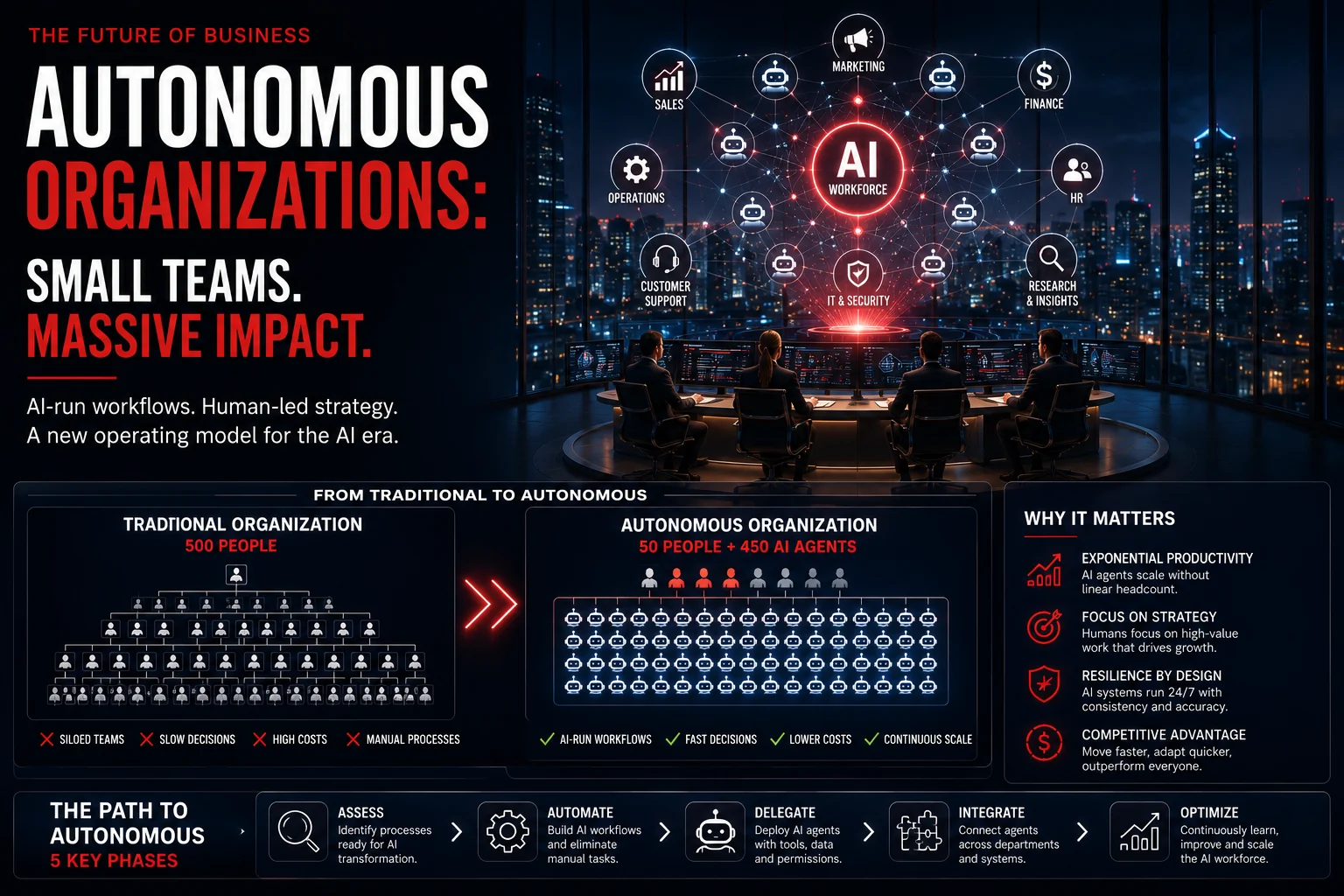
An Autonomous Organization is a business that combines human leadership with AI-powered execution.
The execution layer of an autonomous organization is built from AI agents — goal-driven systems that plan and act across your tools, not just answer questions.
Instead of relying exclusively on human workers to perform operational tasks, autonomous organizations deploy digital employees, AI agents, automation systems, and intelligent workflows to handle a significant portion of daily operations.
Humans remain responsible for vision, leadership, strategy, creativity, relationship building, governance, and final decision-making.
AI systems increasingly manage execution, analysis, monitoring, coordination, reporting, optimization, and routine decision-making.
The result is a new operating model where humans lead and AI executes.
The Evolution of Organizations
Business structures have evolved continuously. Manual organizations depended entirely on human labor. Digital organizations used software to improve productivity. Automated organizations made workflows partially automated. AI-assisted organizations began supporting employees with AI. AI-driven organizations let AI influence decisions. And autonomous organizations let AI systems actively execute operations while humans focus on leadership.
This evolution is not theoretical. It is already happening. Across industries, organizations are deploying AI systems capable of performing work that previously required entire teams.
Why This Model Emerged
Several forces have converged: advances in Generative AI, AI agents capable of taking action, lower technology costs, global labor shortages, increasing operational complexity, and competitive pressure.
Businesses are searching for ways to do more with fewer resources. Autonomous organizations provide a compelling answer.
Human-Led, AI-Executed Operations
The defining characteristic of an autonomous organization is not the absence of humans. It is the intelligent distribution of work between humans and machines.
The future is not human versus AI. The future is human plus AI.
From Employees to Human-AI Teams
The workforce is evolving. For decades organizations relied on a relatively simple model. People performed work. Software supported them. That model is expanding.
The Traditional Workforce
Organizations historically consisted of employees, contractors, and vendors. These groups collectively executed business operations.
The New Workforce Layer
Today a fourth category is emerging: digital employees. Digital employees are AI-powered systems assigned specific responsibilities inside the organization, such as a Sales Development Agent, Marketing Content Agent, Customer Success Agent, Research Agent, Financial Reporting Agent, or Recruiting Agent. These systems operate alongside human teams.
AI Agents Become Team Members
As AI capabilities mature, businesses increasingly treat agents as workforce assets. Each agent may possess defined responsibilities, memory, tools, permissions, performance metrics, and reporting structures. This creates hybrid teams composed of both humans and AI systems.
The Workforce Evolution Timeline
Employees → Employees plus Software → Employees plus Automation → Employees plus AI → Employees plus AI Agents → AI-Native Organization
This progression will define the future of work over the next decade.
What Changes Inside an Autonomous Organization?
The transition to an autonomous organization affects every department. The transformation goes far beyond automation. It changes how decisions are made, how operations run, and how businesses scale.
Decision Making
Historically, leaders relied on historical reports and periodic reviews. Autonomous organizations operate differently. AI systems continuously analyze market conditions, customer behavior, financial performance, operational efficiency, and competitive intelligence. Leaders receive real-time recommendations rather than static reports.
Instead of asking what happened, organizations ask what will happen next. AI identifies risks, opportunities, emerging trends, and resource requirements before humans recognize them.
The best autonomous organizations maintain human oversight. AI provides recommendations. Humans provide judgment.
Operations
Operations become increasingly autonomous. AI systems coordinate workflows across departments, including project management, resource allocation, documentation, scheduling, and process monitoring. Autonomous workflows eliminate bottlenecks and reduce manual intervention. Organizations become more responsive and efficient.
Marketing
Marketing is one of the first departments experiencing AI transformation. AI systems now support content creation, SEO, GEO, campaign optimization, audience analysis, and competitive monitoring. Future marketing departments may consist of a small team overseeing dozens of specialized AI agents. Organizations gain the ability to scale marketing output without proportionally increasing headcount.
In practice, much of this marketing shift is about visibility inside AI answers — the discipline of AI search and GEO that determines whether AI systems recommend your brand at all.
Sales
Sales operations are rapidly becoming AI-enabled. AI agents can identify prospects, qualify leads, personalize outreach, generate proposals, update CRM systems, and forecast revenue. Human sales professionals increasingly focus on relationship building and closing opportunities. Routine sales activities become automated.
Customer Support
Customer support has historically required significant staffing. Autonomous organizations deploy AI-powered support teams capable of resolving common issues, searching knowledge bases, managing tickets, escalating complex cases, and supporting onboarding. This enables organizations to provide round-the-clock support while improving consistency and reducing costs.
Finance
Finance departments benefit significantly from AI systems. Applications include forecasting, budget monitoring, reporting, compliance tracking, expense analysis, and risk identification. Financial leaders gain deeper visibility and faster decision-making capabilities.
The 10-Person Company Running Like a 100-Person Company
This may be the most important business trend of the next decade.
Historically, growth required hiring. More customers required more employees. More projects required larger teams. More revenue required larger operations.
Autonomous organizations challenge that assumption.
AI creates operational leverage. A small team can now coordinate a much larger digital workforce.
Consider two companies. A traditional company might have 100 employees, multiple management layers, high operational overhead, and significant coordination requirements. An autonomous company might have 10 human leaders, 90 digital employees, AI-powered operations, and automated coordination. The second company may produce equivalent — or even greater — output.
AI agents operate continuously. They do not sleep, take vacations, require onboarding, forget processes, or wait for approvals. This dramatically increases productivity per human employee.
The result is not smaller organizations. The result is more capable organizations.
Digital Employees: The New Workforce Layer
Digital employees represent one of the most important concepts in autonomous organizations. They are not chatbots. They are operational entities with defined responsibilities.
Each of these roles is a digital employee: an AI worker with a defined mandate, permissions, and measurable outcomes, managed much like a member of the team.
A marketing employee creates content, optimizes campaigns, and analyzes performance. A sales employee prospects leads, schedules meetings, and maintains CRM data. A finance employee generates reports, monitors budgets, and tracks expenses. A research employee collects intelligence, summarizes findings, and provides recommendations.
Every digital employee should have defined roles with specific responsibilities, memory for historical context, permissions for controlled access, KPIs for measurable outcomes, and accountability through human oversight.
The future workforce will increasingly consist of humans and digital employees working together.
Benefits of Autonomous Organizations
Autonomous organizations deliver faster execution, lower costs, better scalability, continuous operations, better decision making, higher productivity, and greater resilience.
Tasks are completed significantly faster. Operational expenses decrease. Organizations scale output without linear hiring. Work continues around the clock. AI enhances visibility and forecasting. Employees focus on higher-value activities. And organizations become less dependent on individual contributors.
These benefits compound over time. Organizations that adopt autonomous models early may create substantial competitive advantages.
Risks and Challenges
Autonomous organizations are powerful, but they are not without risk.
AI hallucinations can lead to poor decisions when incorrect information is generated. Sensitive systems require strict security controls. Organizations must meet regulatory compliance requirements. Data quality directly impacts AI performance. Employees may resist change. And overreliance on external platforms creates vendor dependency.
Successful organizations address these challenges proactively rather than reactively.
Governance and Human Oversight
Governance is what separates responsible autonomous organizations from dangerous ones.
Critical decisions should involve human review. AI systems should only access necessary resources. Every action should be recorded. Humans remain responsible for outcomes. High-risk actions require authorization. Organizations need clear AI usage policies and ethical frameworks. And governance must align with industry regulations.
The future is not autonomous chaos. It is controlled autonomy.
Building an Autonomous Organization
Organizations should not attempt full autonomy overnight. Transformation happens in stages.
It begins with assessment to identify opportunities, followed by opportunity mapping to prioritize high-impact workflows, agent deployment to introduce specialized AI agents, an automation layer to connect systems and workflows, a governance layer to implement controls and oversight, scaling to expand successful deployments, and continuous optimization to monitor and improve performance.
The maturity roadmap runs from Manual to Digital to Automated to AI Assisted to AI Driven to Autonomous Organization.
Most organizations today are between the early and middle stages. The leaders of tomorrow will reach the governance and scaling stages first.
Future Predictions
The next decade will transform organizational design more dramatically than any period since the Industrial Revolution.
New companies will be designed around AI from day one. Every organization will manage digital workers. AI agents will coordinate entire departments. Routine work will increasingly execute itself. Organizations will manage business activities through AI-driven operating platforms. And humans will focus on vision, leadership, creativity, relationships, and innovation.
Execution will increasingly become automated. The organizations of the future may resemble intelligent ecosystems more than traditional companies.
Conclusion
Autonomous organizations represent the next evolution of business. They combine human leadership, AI agents, digital employees, automation systems, and intelligent workflows into a unified operating model capable of achieving extraordinary levels of efficiency and scalability.
The future of work is not about replacing humans. It is about amplifying human capability through intelligent systems.
Organizations that embrace this shift early will gain advantages in productivity, speed, innovation, and growth.
The question is no longer whether autonomous organizations will emerge. The question is which organizations will lead the transformation — and which will struggle to catch up.