Part of our Artificial Intelligence in Business series — a complete executive guide to putting AI to work across your organization.
AI Is Learning to Understand the World, Not Just Words
For the past several years, the AI conversation has been dominated by language models. ChatGPT, Claude, Gemini, and other generative AI systems have demonstrated an extraordinary ability to understand and generate human language. They can write reports, summarize research, create marketing campaigns, generate software code, and answer complex questions.
Yet language represents only a small fraction of how humans experience reality.
We do not navigate the world through text alone. We see. We hear. We observe movement. We understand environments. We combine countless signals simultaneously to make decisions.
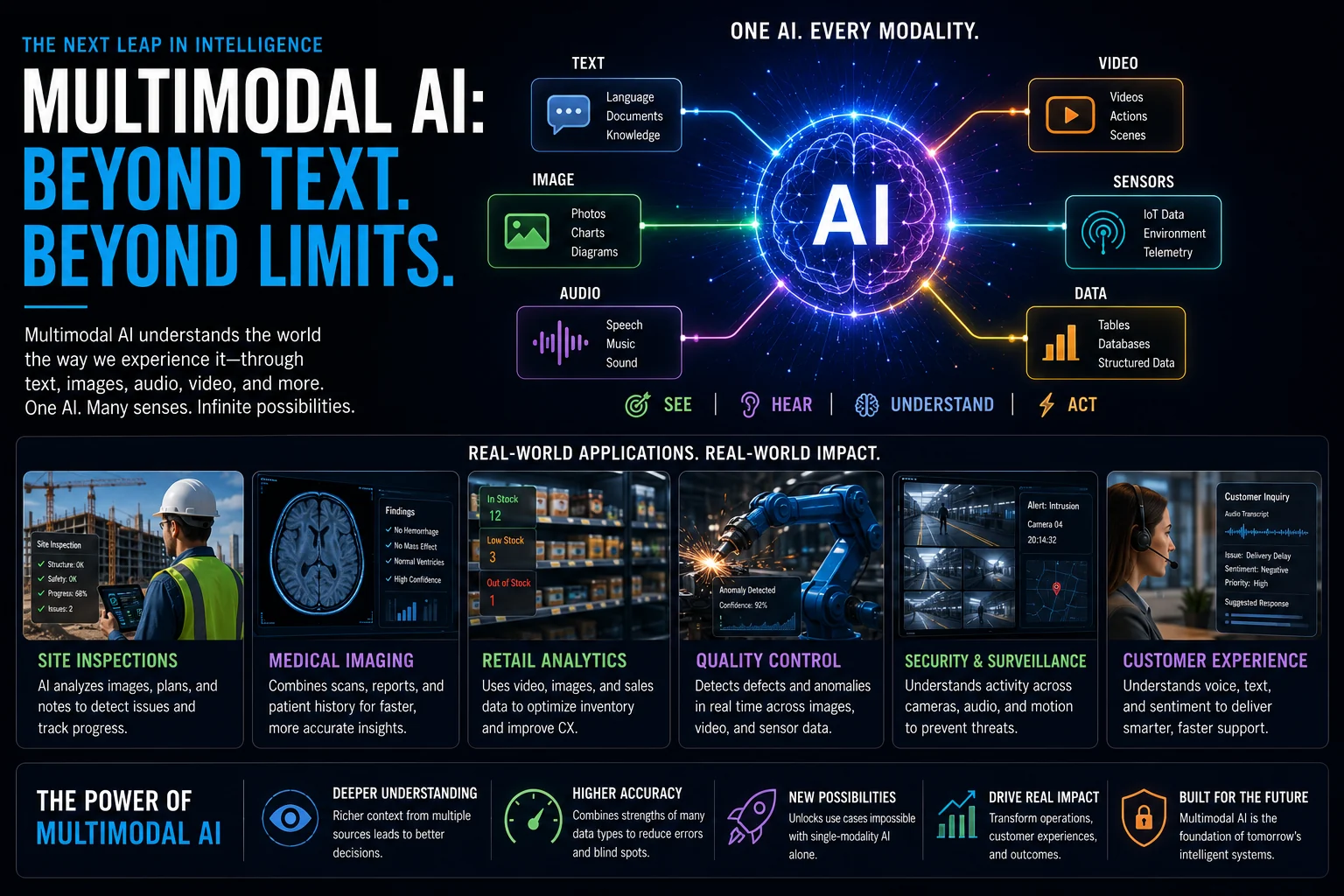
The next major evolution in artificial intelligence is not simply bigger language models. It is Multimodal AI — AI systems capable of understanding and reasoning across text, images, audio, video, documents, sensors, and physical environments simultaneously.
This shift represents one of the most significant advancements in AI history. It moves artificial intelligence from understanding language toward understanding reality itself.
For businesses, the implications are profound. Healthcare, manufacturing, construction, security, insurance, retail, legal services, logistics, and countless other industries are about to be transformed by AI systems that can perceive the world almost as humans do.
What Is Multimodal AI?
Multimodal AI refers to artificial intelligence systems capable of processing and understanding multiple forms of information at the same time.
Traditional AI systems typically focus on a single modality, such as text models, speech recognition systems, image recognition systems, or recommendation engines. Each operates within a limited information domain. Multimodal AI combines these capabilities into a unified intelligence system.
Humans rarely rely on a single source of information. Imagine walking into a meeting. You simultaneously process facial expressions, body language, speech, tone of voice, documents, context, and past experiences. Your understanding comes from integrating all of these signals. Multimodal AI attempts to replicate this process.
The Evolution of AI
The progression has occurred in stages: Text AI → Language Models → Vision Models → Multimodal AI → Digital Perception.
AI is gradually acquiring additional senses. Instead of understanding only language, it is learning to interpret the broader world.
Why Multimodal AI Matters
The real world is not organized into neat text prompts. Businesses generate information through images, video feeds, audio recordings, documents, sensor networks, physical inspections, and human interactions. AI systems capable of understanding these signals unlock entirely new categories of business value.
Why Text Is Not Enough
Language models are powerful, but they have limitations. Most information generated by businesses exists outside text.
Factories generate video feeds. Construction sites generate photographs. Healthcare organizations produce scans and medical imagery. Retail stores generate visual customer behavior data. Much of the world's information is image-based.
Conversations matter. Customer calls matter. Machine sounds matter. Voice communications often contain insights that text cannot fully capture.
Context frequently determines meaning. A photograph without context can be misleading. A document without supporting visuals may be incomplete. A conversation without tone may lose critical information.
Organizations increasingly collect information through cameras, microphones, drones, IoT sensors, inspection systems, and mobile devices. Traditional AI struggles to connect these sources. Multimodal AI excels at it. The future belongs to systems capable of understanding information regardless of format.
AI That Can See: Computer Vision
Computer vision is one of the largest and fastest-growing areas of AI. It enables machines to interpret visual information.
Modern AI systems can analyze photographs with remarkable accuracy, identifying objects, people, environments, damage, defects, and activities. AI can detect and classify thousands of object types in real time, with applications including inventory tracking, warehouse operations, autonomous vehicles, and security monitoring.
Manufacturers increasingly use AI vision systems to identify quality issues that humans may miss, reducing waste, improving quality, and accelerating inspections. Healthcare providers use computer vision to analyze X-rays, CT scans, MRI scans, and pathology images, assisting clinicians in identifying patterns and anomalies. Robots and autonomous machines rely heavily on computer vision, because without sight, autonomy becomes impossible. And retailers use visual AI to understand store traffic, shelf inventory, customer behavior, and product placement effectiveness.
Computer vision gives AI the ability to see. Multimodal AI combines that vision with reasoning.
AI That Can Hear
Hearing is another critical capability. Audio contains enormous amounts of valuable information.
Modern AI can accurately convert spoken language into text, enabling transcription, documentation, and searchability. Businesses increasingly analyze customer calls to identify satisfaction, intent, risks, and opportunities. AI systems can summarize discussions, identify action items, and track decisions automatically. Voice-based AI agents are becoming increasingly sophisticated, able to answer questions, resolve issues, and route inquiries.
Machines produce unique sound signatures, and changes often indicate mechanical problems, so AI can identify anomalies before failures occur. Audio analysis can also assist with respiratory monitoring, speech analysis, and behavioral assessments.
Hearing allows AI to capture information unavailable through text alone.
Understanding Video
Video is one of the richest information sources available. Unlike images, video adds motion, behavior, and context.
AI can analyze movement patterns over time and identify activities, interactions, and anomalies. AI-powered video systems detect suspicious behavior, unauthorized access, and potential threats. Professional teams increasingly use AI to analyze performance and strategy. Production lines generate continuous streams of visual information, and AI can monitor quality, efficiency, and safety simultaneously. Video analytics reveal customer movement, traffic patterns, and product engagement. And organizations use AI to evaluate procedures and identify opportunities for improvement.
Video transforms AI from observation into understanding.
Understanding Physical Environments
One of the most important developments in AI is environmental awareness. AI is evolving beyond information processing. It is learning to understand spaces.
This environmental understanding is what gives AI robotics its intelligence — perception is the bridge between reasoning and physical action.
Modern AI systems increasingly understand distance, position, movement, and physical relationships. Robots require environmental awareness to operate safely, and multimodal systems provide that capability. Autonomous vehicles, warehouse systems, and industrial robots all depend on environmental understanding. AI can evaluate facilities using images, drone footage, sensor data, and historical records. Multimodal systems help machines understand dynamic environments. Factories increasingly combine cameras, sensors, machines, and production data into a unified intelligence layer. And digital twins create virtual representations of real-world environments that AI can monitor, analyze, and optimize continuously.
The future of AI is not simply understanding information. It is understanding environments.
Multimodal AI Across Industries
Multimodal AI is already reshaping how entire industries operate.
In healthcare, AI can analyze scans rapidly and consistently, help identify patterns that support clinical decision-making, and combine imaging, records, laboratory data, and clinical observations to create richer insights. It continuously evaluates patient data streams, provides support during procedures, automatically converts conversations into structured records, and identifies risks earlier by combining multiple information sources. Healthcare is moving from reactive care toward predictive intelligence.
In manufacturing, multimodal AI makes visual inspections faster and more accurate, monitors performance continuously, identifies defects before they become costly problems, combines sensors, images, and machine sounds to predict failures, detects unsafe conditions in real time, and provides visibility into every stage of production.
In construction, AI evaluates project sites using visual and sensor data, tracks development against plans with drone imagery, identifies hazards automatically, monitors machines continuously, and improves reporting and coordination with visual evidence.
In security, AI monitors environments continuously, detects suspicious behavior automatically, reveals risks before incidents occur, strengthens identity verification, provides proactive visibility into security concerns, and improves response times through rapid detection.
In retail, AI helps understand customer interactions, tracks shelf conditions automatically, provides deeper insight into shopping patterns, makes product availability easier to manage, creates increasingly autonomous retail experiences, and improves operational security.
In insurance, AI evaluates information faster than traditional workflows, improves accuracy with images and video, makes patterns easier to identify for fraud detection, combines multiple data sources into comprehensive risk assessments, enables remote property inspections, and supports better underwriting decisions.
In legal services, AI analyzes contracts and legal documents rapidly, helps identify relevant events and patterns in video evidence, makes audio recordings searchable and analyzable, improves efficiency and consistency in contract analysis, assists with case preparation and discovery, and makes regulatory compliance monitoring more proactive.
The Future of Multimodal AI
The next decade will bring capabilities that extend far beyond today's systems.
Multimodal perception is also what will let AI agents operate in the physical world, not just across software — seeing, hearing, and acting on the same context a person would.
AI will increasingly understand the world through multiple senses. Systems will reason about environments, not just information. Machines will gain deeper awareness of how physical systems operate. AI agents will use multimodal perception to execute complex tasks. Robots will become more capable because they can better understand their surroundings. Businesses will increasingly rely on AI-driven operations. Virtual environments will mirror physical operations continuously through digital twins. And organizations may eventually manage entire operations through AI-powered intelligence layers.
The future is not AI that understands documents. The future is AI that understands reality.
From Language Models to World Models
The evolution of artificial intelligence is moving toward a profound milestone. Today, AI understands language. Tomorrow, AI will understand the world.
Together, these capabilities feed the autonomous organization — where AI perceives, reasons, and acts across every channel a business touches.
Language models represented a major breakthrough. Multimodal systems represent something even larger. They bring AI closer to human perception.
The next generation of intelligence will not simply read information. It will observe, interpret, reason, and act across the physical and digital worlds simultaneously.
The biggest leap in AI is not smarter chatbots. It is machines capable of perceiving reality itself. Organizations that prepare for this transition today will be positioned to lead tomorrow.
Conclusion
Multimodal AI is rapidly becoming one of the most transformative technologies in business. From healthcare and manufacturing to legal services, construction, retail, insurance, and security, organizations are discovering new ways to combine visual intelligence, audio analysis, environmental understanding, and AI reasoning into powerful competitive advantages.
The question is no longer whether multimodal AI will impact your industry. The question is how quickly your competitors will implement it.