Introduction
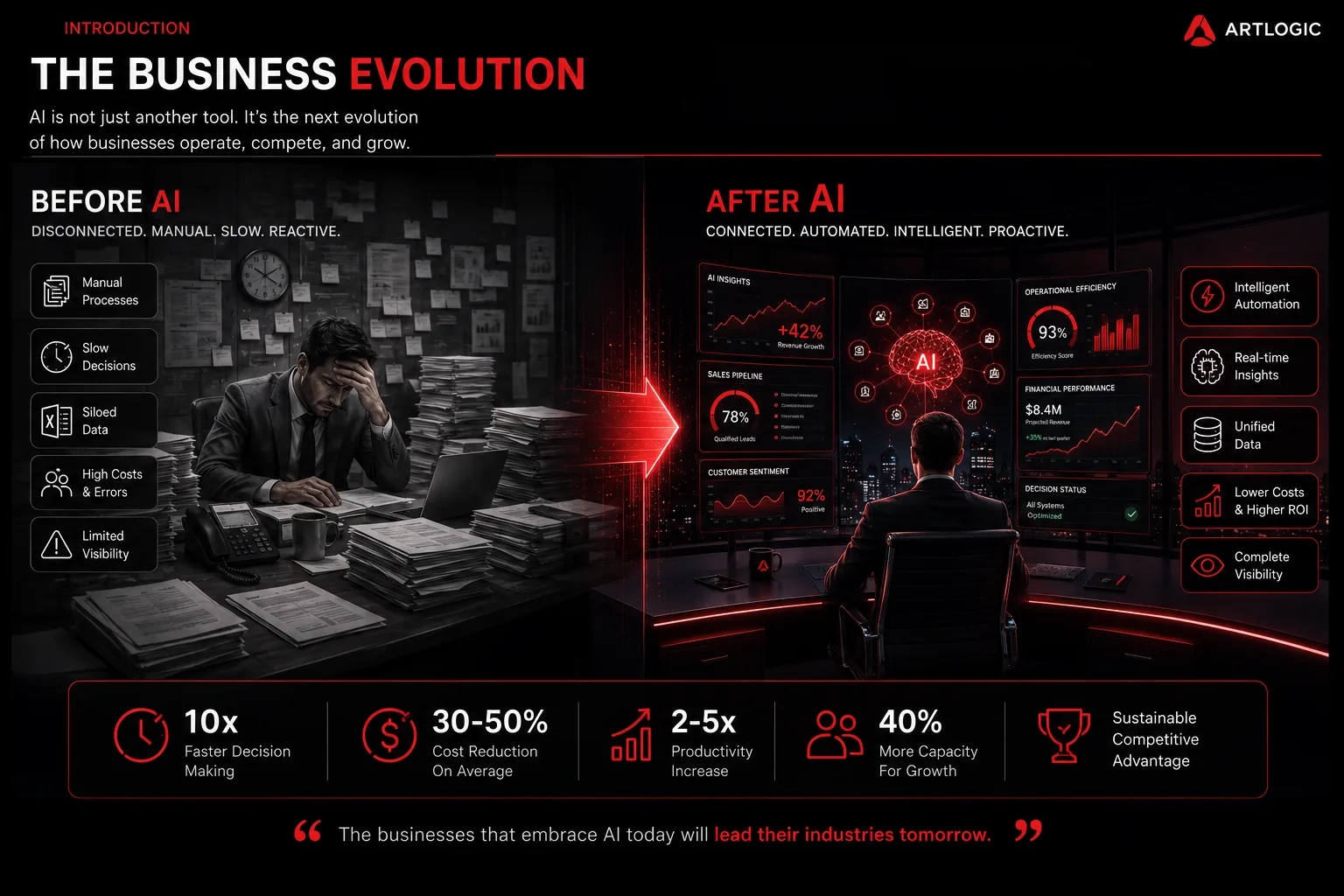
Every major technological revolution has created new market leaders. Electricity transformed manufacturing. The internet transformed communication. Smartphones transformed consumer behavior. Cloud computing transformed how software gets built and sold.
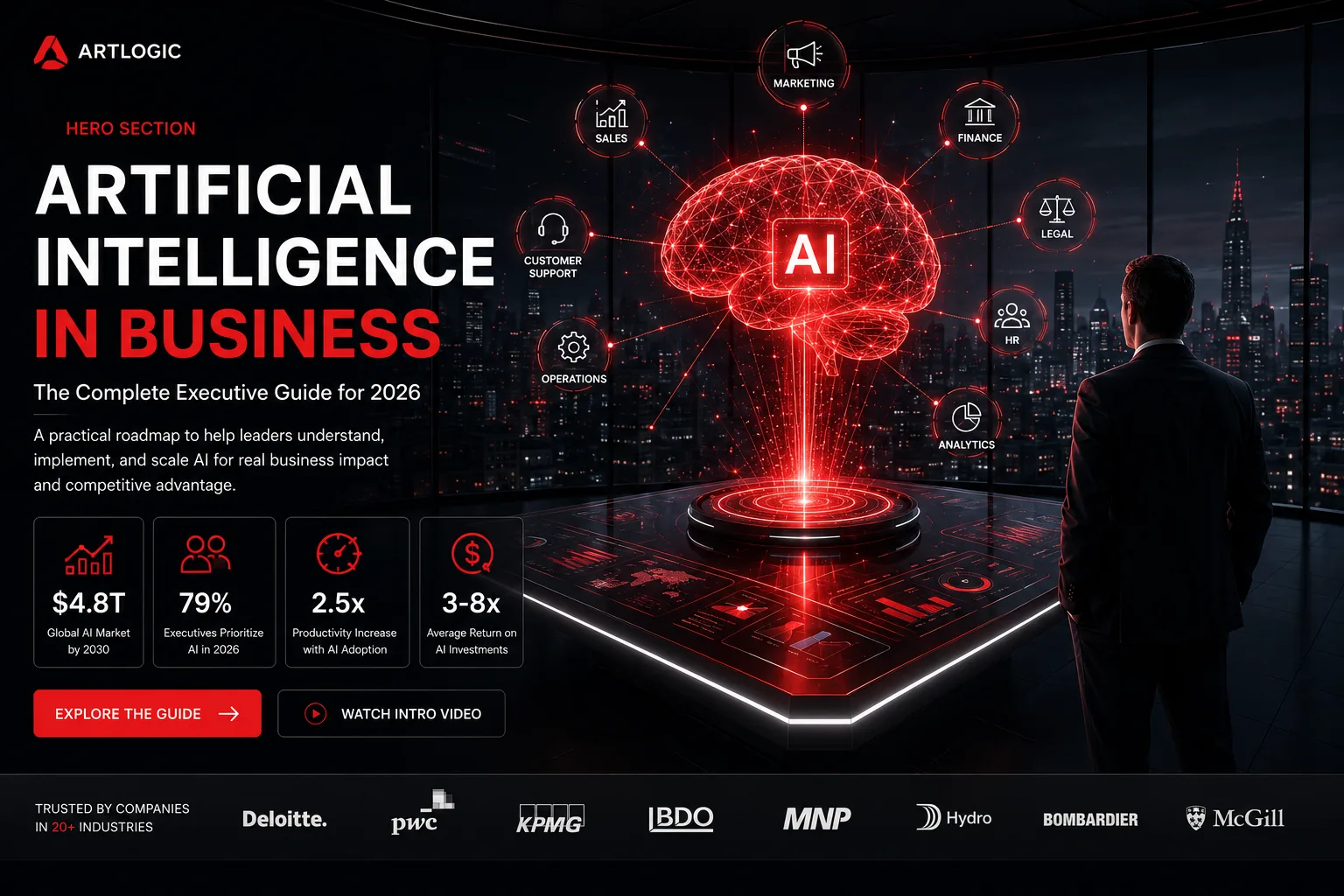
Artificial intelligence is transforming every business function simultaneously — marketing, sales, operations, finance, legal, HR, customer support, and product development — at the same time, in the same organizations, often within the same fiscal year.
That simultaneity is what makes this shift different from the ones before it. Electricity took decades to move from novelty to infrastructure. AI is moving from novelty to infrastructure in quarters.
The question facing CEOs, founders, and operators today is no longer whether to adopt artificial intelligence. It is how fast, where to start, and how to do it without breaking what already works.
This guide is written for the people who have to make that call: executives, founders, partners at law firms, plant managers at manufacturers, and leaders at professional services and healthcare organizations who need a practical, no-hype map of what AI actually is, what it actually does for a business, what it costs, what can go wrong, and how to start.
We built this guide because most "What is AI?" content on the internet is written for consumers, not decision-makers. It explains chatbots. It doesn't explain P&L impact, implementation sequencing, governance, or ROI. This does.
1. What Is Artificial Intelligence in Business?
At its simplest, artificial intelligence in business means using software that can perform tasks which previously required human judgment, perception, or language understanding — at a fraction of the time and cost, and increasingly, with the ability to act autonomously on a business's behalf.
That's a broad definition on purpose, because "AI" is really an umbrella term covering several distinct technologies stacked on top of each other. Understanding the layers matters, because each layer has different capabilities, costs, and risk profiles — and vendors routinely blur them to make simpler tools sound more advanced than they are.
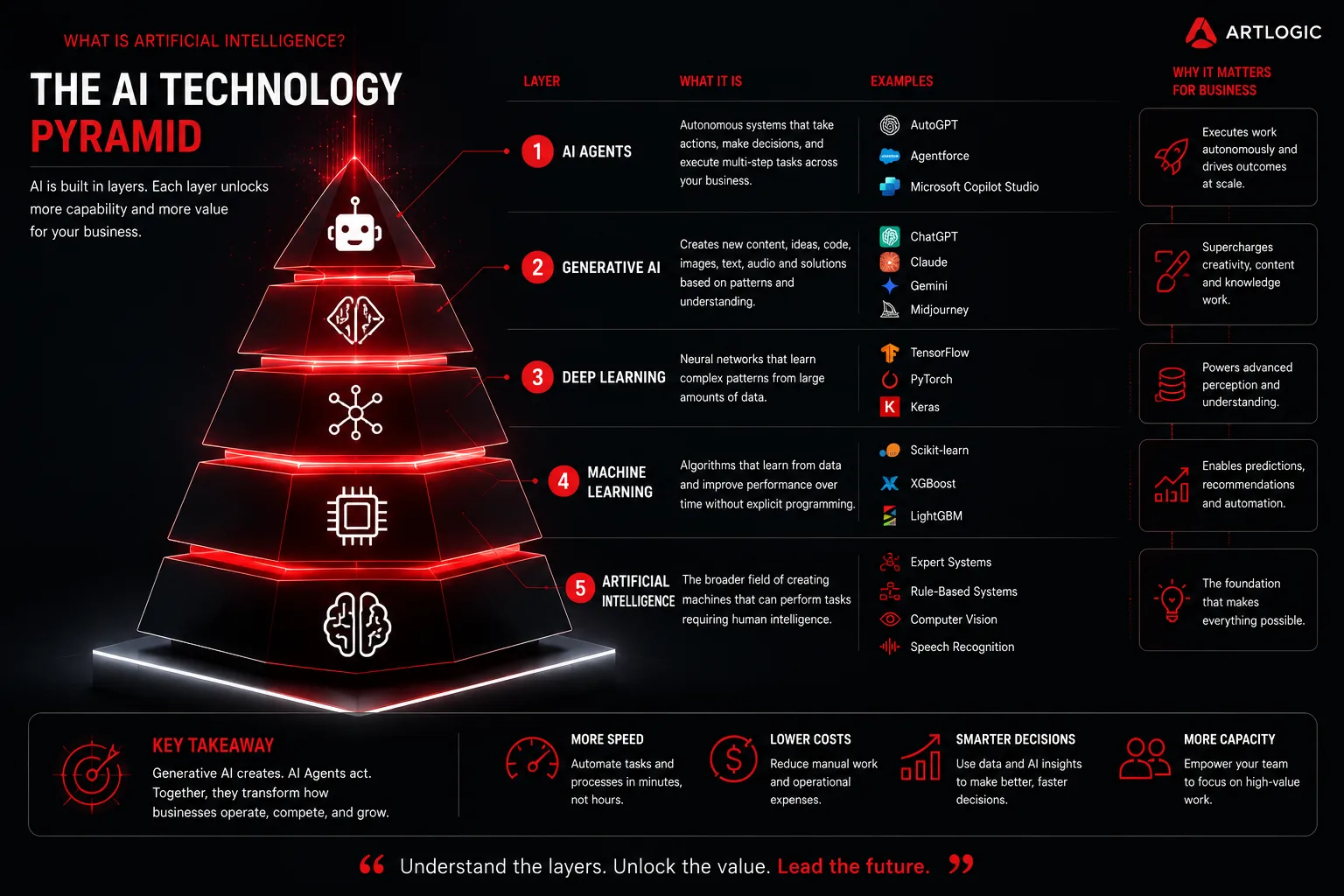
- Artificial Intelligence (AI) — the umbrella field: any technique that lets a computer system mimic aspects of human intelligence, from rule-based expert systems built in the 1980s to today's language models.
- Machine Learning (ML) — a subset of AI where systems learn patterns from data instead of following hand-written rules, like a fraud-detection model that learns what suspicious transactions look like from millions of past examples.
- Deep Learning (DL) — a subset of ML using layered neural networks, loosely inspired by the brain, that can learn far more complex patterns; image recognition, speech-to-text, and the foundations of modern language models all rely on deep learning.
- Generative AI — deep learning systems trained to produce new content — text, images, code, audio, video — rather than just classify or predict. ChatGPT, Claude, Gemini, and Midjourney are generative AI.
- AI Agents — the newest and most consequential layer: generative AI systems given the ability to take actions, not just generate text. An agent can read your inbox, check your CRM, draft a reply, update a record, and escalate to a human — as a chained sequence of decisions, not a single response to a single prompt.
For a business leader, the layers that matter most right now are the top two: generative AI, which produces content and answers, and AI agents, which take multi-step action. Everything below that is infrastructure most executives will never touch directly — it's built into the tools they buy.
2. Why AI Matters Now
AI has existed as a research field since the 1950s. What changed is not the underlying math — it's accessibility, cost, and capability crossing a threshold that made deployment inside ordinary businesses viable.
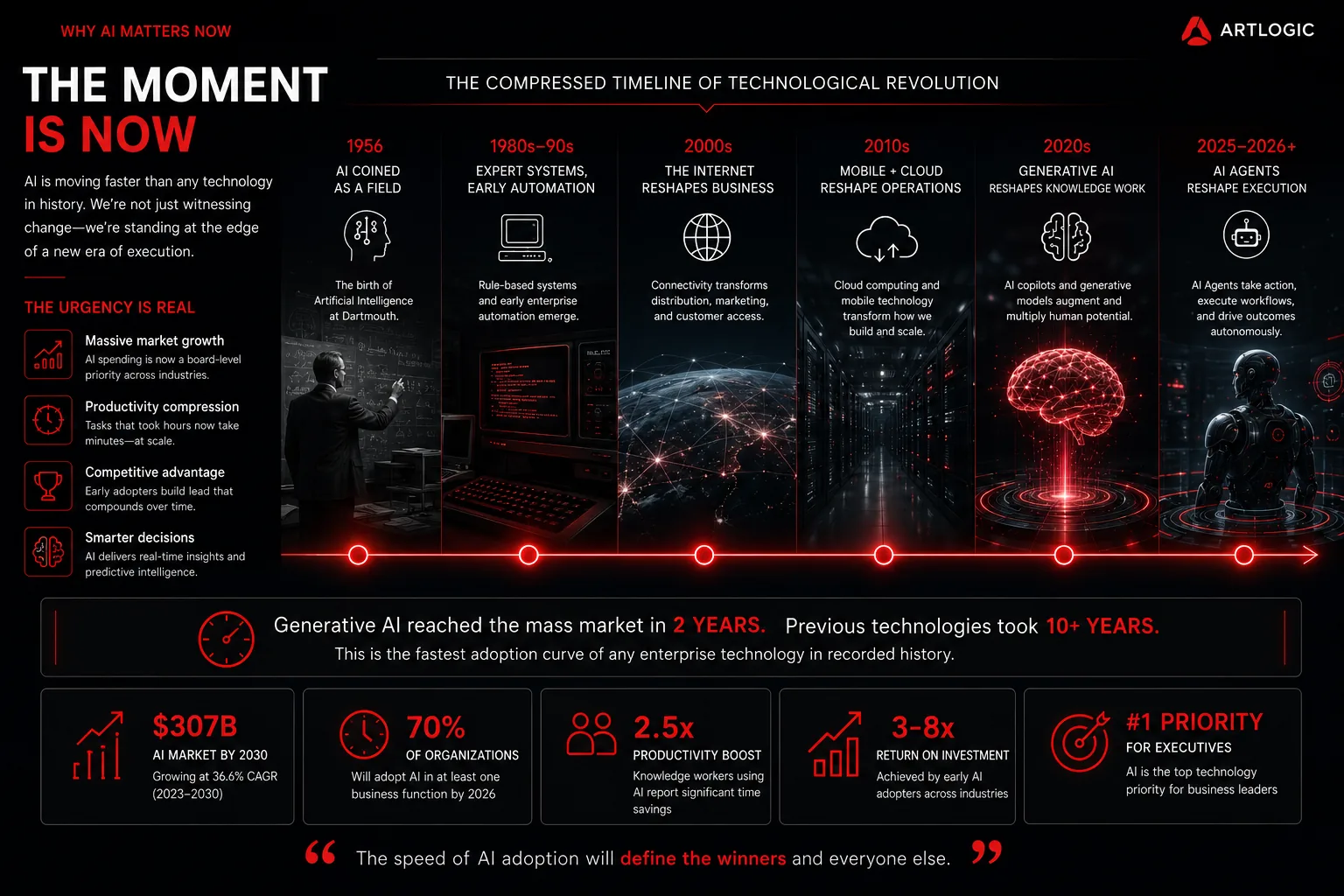
- 1956 — AI is coined as a field at Dartmouth.
- 1980s–90s — Expert systems and early automation emerge.
- 2000s — The internet reshapes distribution and marketing.
- 2010s — Mobile and cloud reshape operations and infrastructure.
- 2020s — Generative AI reshapes knowledge work.
- 2025–2026 — AI agents reshape execution, not just output.
Each wave took roughly a decade to fully diffuse through the average business. Generative AI diffused into daily use inside two years of ChatGPT's public launch — the fastest adoption curve of any enterprise technology on record.
- Market growth — enterprise AI spending has moved from experimental budget line to board-level line item in most mid-market and large organizations within the last 24 months.
- Productivity compression — tasks that took a knowledge worker hours, like drafting a first-pass contract, summarizing a claims file, or building a marketing brief, now take minutes with a human reviewing and refining rather than starting from a blank page.
- Competitive advantage compounds — a firm that automates client intake, document review, or lead qualification six months before a competitor doesn't just save six months of cost; it reinvests that saved capacity into growth while the competitor is still hiring.
- Decision-making is getting faster and more data-grounded — AI-assisted analytics let smaller teams do what used to require a dedicated BI function.
- Customer expectations have shifted — clients now expect 24/7 responsiveness, personalized communication, and fast turnaround as a baseline, not a premium feature, because they experience it from AI-native companies elsewhere.
The organizations winning this transition aren't necessarily the ones with the biggest AI budgets. They're the ones that moved from "we should look into AI" to a working pilot the fastest, and iterated from there.
3. Benefits of AI for Business
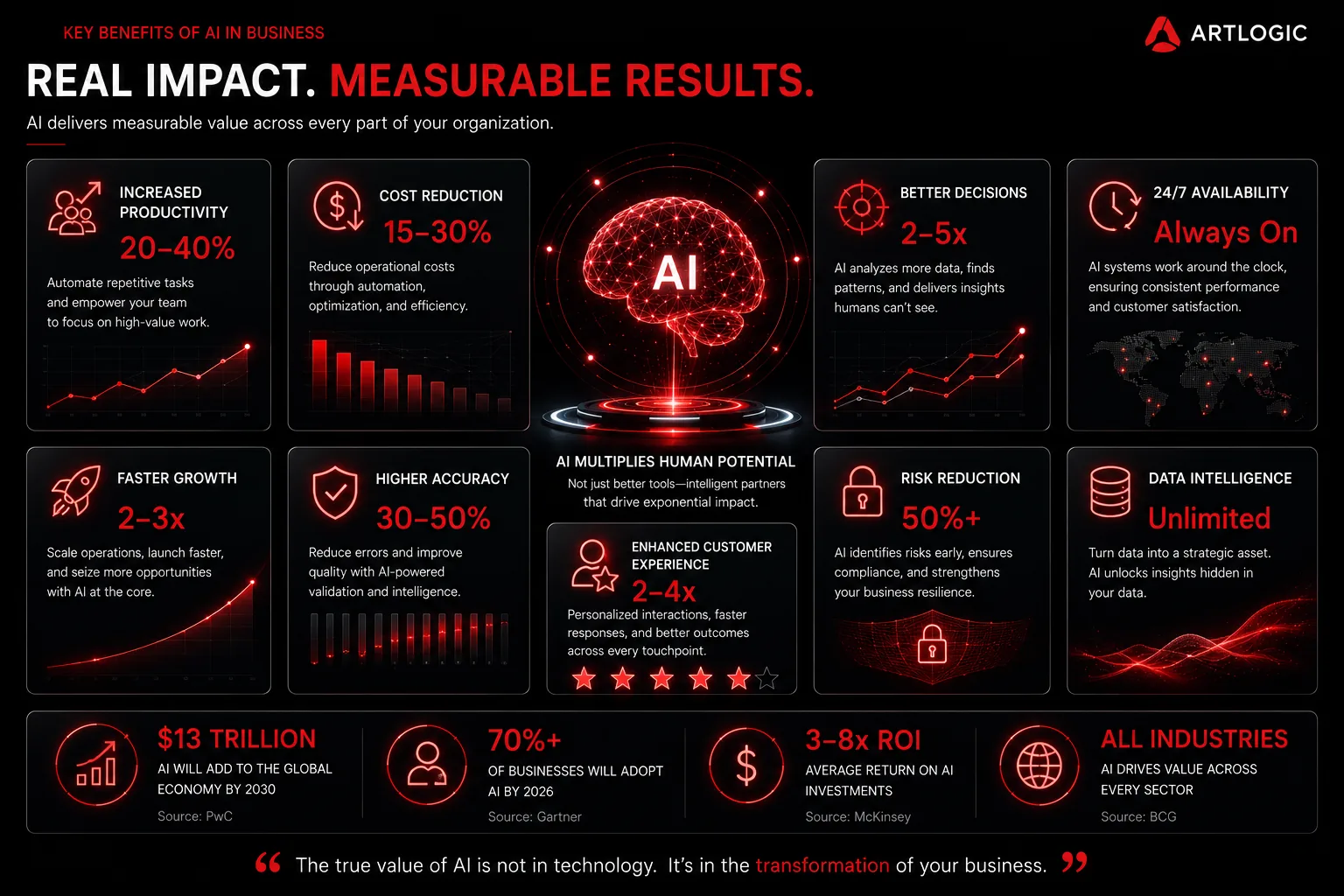
- Increased productivity — teams complete more output per hour by offloading drafting, research, and first-pass analysis to AI, reserving human time for judgment and review.
- Reduced operating costs — automation of repetitive workflows like data entry, scheduling, follow-ups, and document processing reduces the headcount needed to run steady-state operations.
- Better decision-making — AI-assisted analytics surface patterns in sales, operations, and financial data that would take a human analyst days to find manually.
- 24/7 availability — AI-powered support and intake don't sleep, don't take holidays, and don't have time zones, closing the gap between when customers need help and when your team is staffed.
- Personalization at scale — AI can tailor marketing, onboarding, and support to the individual customer without the linear cost increase that personalization used to require.
- Automation of repetitive work — releasing skilled staff — lawyers, engineers, accountants, marketers — from low-value repetitive tasks so they spend more time on the work that actually requires their expertise.
- Faster growth cycles — shorter time from lead to qualified opportunity, from draft to shipped content, from inquiry to signed engagement.
- Higher profitability per employee — the combination of the above compounds into higher revenue-per-employee, which is increasingly the metric investors and acquirers use to evaluate operational maturity.
None of these benefits are automatic. They are the result of deliberate implementation — which is why the roadmap later in this guide matters more than the technology itself.
4. Business Functions Using AI
AI is not a single department's tool. It cuts horizontally across the entire organization. Here is how it shows up, function by function.
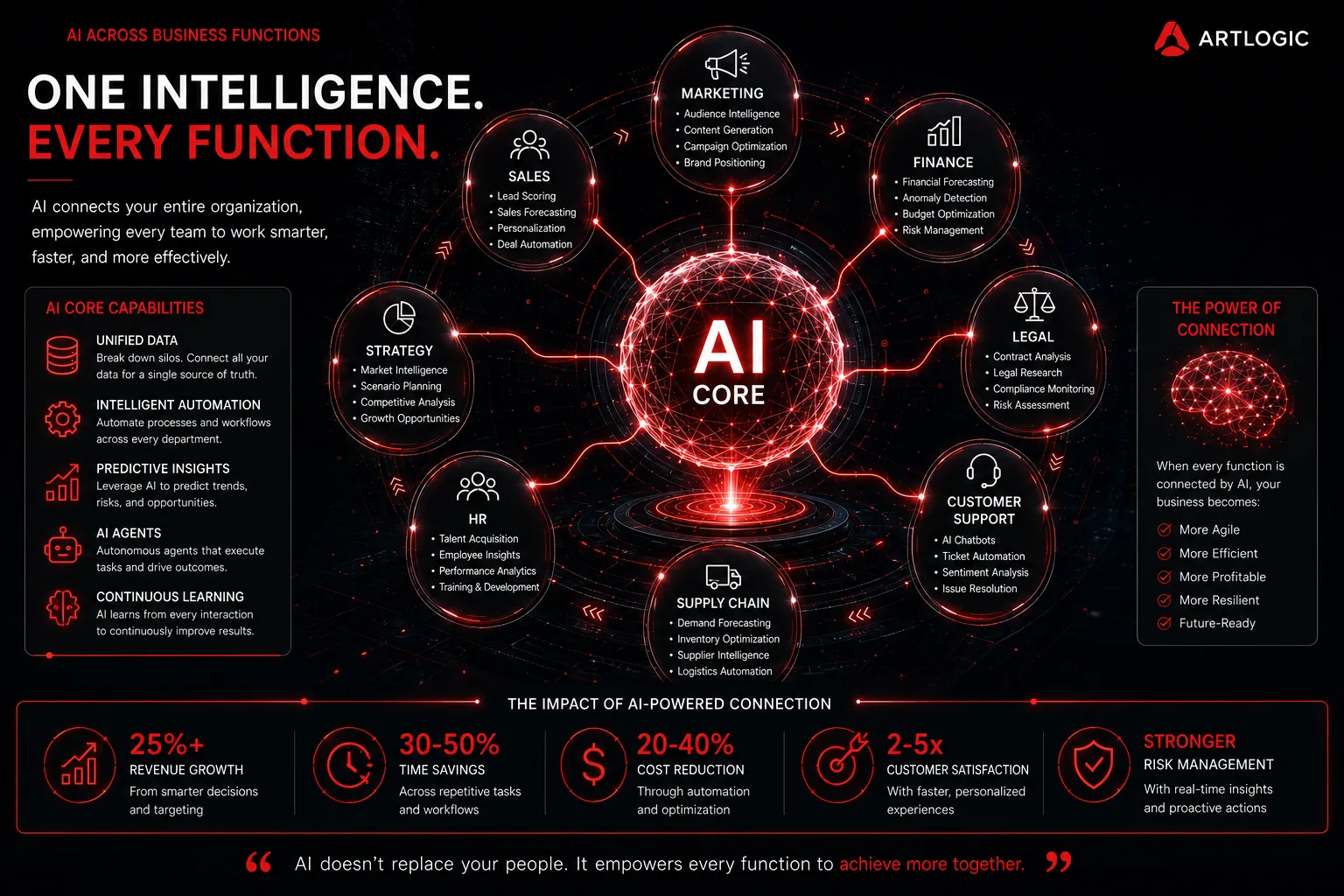
- Marketing — content generation, SEO and GEO optimization, ad targeting, campaign analytics, personalized email sequences, brand monitoring.
- Sales — lead scoring, qualification, CRM enrichment, proposal drafting, call summarization, pipeline forecasting.
- Customer Service — AI chat and voice support, ticket triage and routing, knowledge-base-grounded answers, sentiment analysis, 24/7 first-response coverage.
- HR — resume screening, interview scheduling, onboarding document generation, employee Q&A assistants, policy drafting support.
- Legal — contract review and redlining, legal intake triage, case research summarization, document drafting, compliance monitoring.
- Finance — forecasting, anomaly and fraud detection, invoice processing, expense categorization, financial reporting drafts.
- Manufacturing — visual quality inspection, predictive maintenance, production scheduling optimization, defect detection.
- Supply Chain — demand forecasting, inventory optimization, supplier risk monitoring, logistics routing.
- Healthcare — clinical documentation support, patient intake and scheduling, insurance and claims processing, diagnostic imaging assistance under appropriate clinical oversight.
- Education — personalized learning paths, administrative automation, tutoring and content support, grading assistance.
- Construction — project scheduling, site safety monitoring via computer vision, bid and estimate drafting, document management.
- Real Estate — lead qualification, listing description generation, market analysis, virtual property tours, transaction document processing.
- Professional Services — proposal and SOW drafting, research synthesis, client reporting, time and billing automation, knowledge management.
The pattern across every one of these functions is the same: AI takes over the repetitive, document-heavy, time-sensitive layer of the work, and humans move up to judgment, relationships, and exception-handling.
5. Real Business Examples
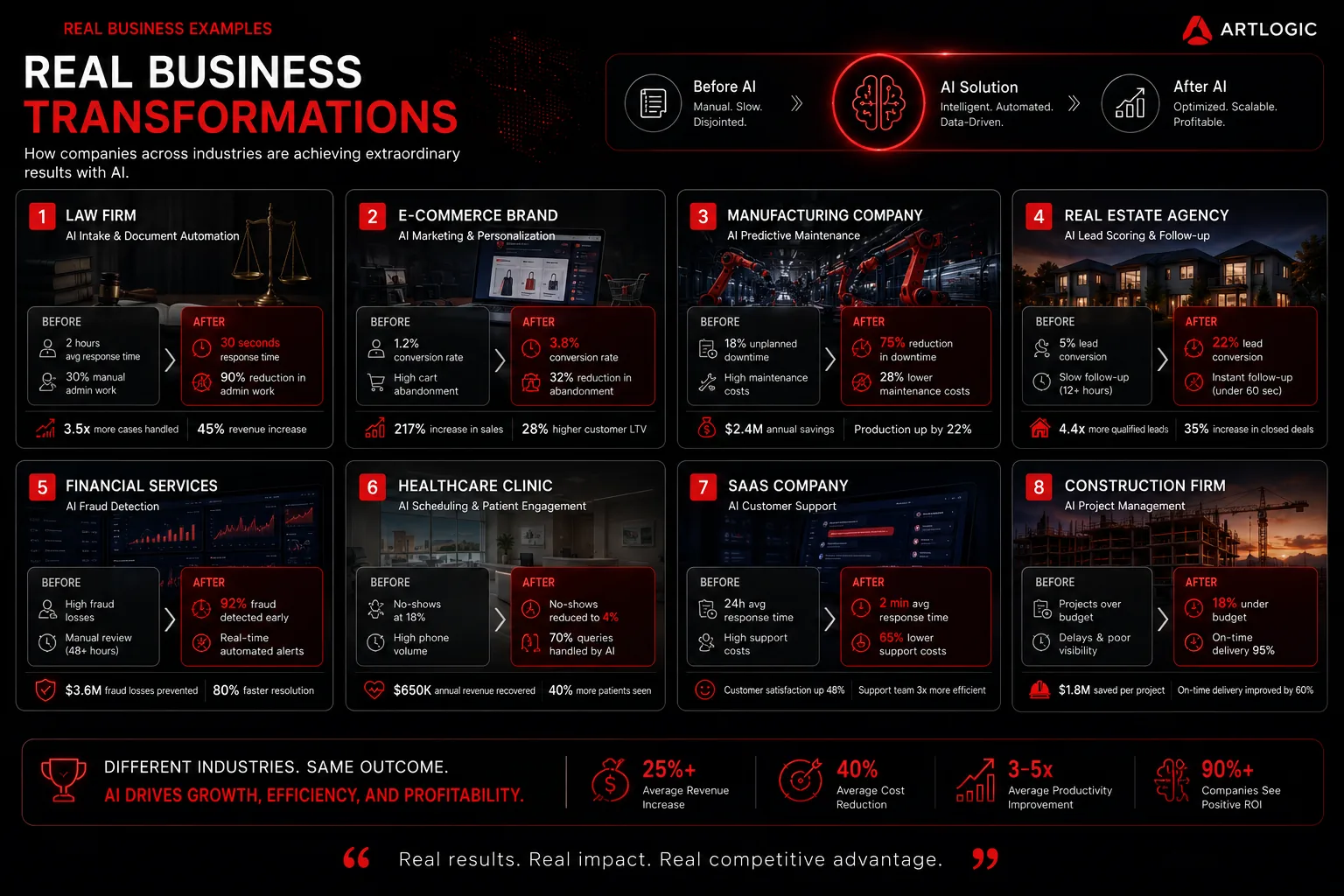
- Marketing — SEO and lead generation: a professional services firm uses AI to research keyword clusters, draft long-form content, and generate structured data markup — cutting content production time from weeks to days while increasing organic visibility.
- Sales — legal intake: a law firm deploys an AI intake assistant that qualifies inbound inquiries 24/7, captures case details, and routes urgent matters to an attorney immediately instead of waiting for the next business day — recovering leads that would otherwise go to a competitor who answers first.
- Manufacturing — visual inspections: a manufacturer trains a computer-vision model on historical defect images to catch quality issues on the line in real time, reducing scrap rate and warranty claims without adding headcount to the QA team.
- Finance — forecasting: a mid-market company replaces a manual spreadsheet-based forecasting process with an AI-assisted model that ingests real-time sales and inventory data, cutting forecast variance and releasing the finance team from a multi-day monthly close ritual.
- Operations — inventory: a retailer uses AI demand forecasting to reduce both stockouts and overstock simultaneously — a combination that was nearly impossible to optimize manually because the two failure modes pull in opposite directions.
- Customer support — 24/7 coverage: a growing SaaS company deploys an AI-first support layer that resolves the majority of tier-1 tickets instantly and hands off complex cases to human agents with full context already attached — reducing average response time from hours to seconds.
- HR — recruitment: a company uses AI to screen and rank inbound applications against role criteria, cutting the time recruiters spend on manual resume review while surfacing candidates that keyword-based ATS filters previously missed.
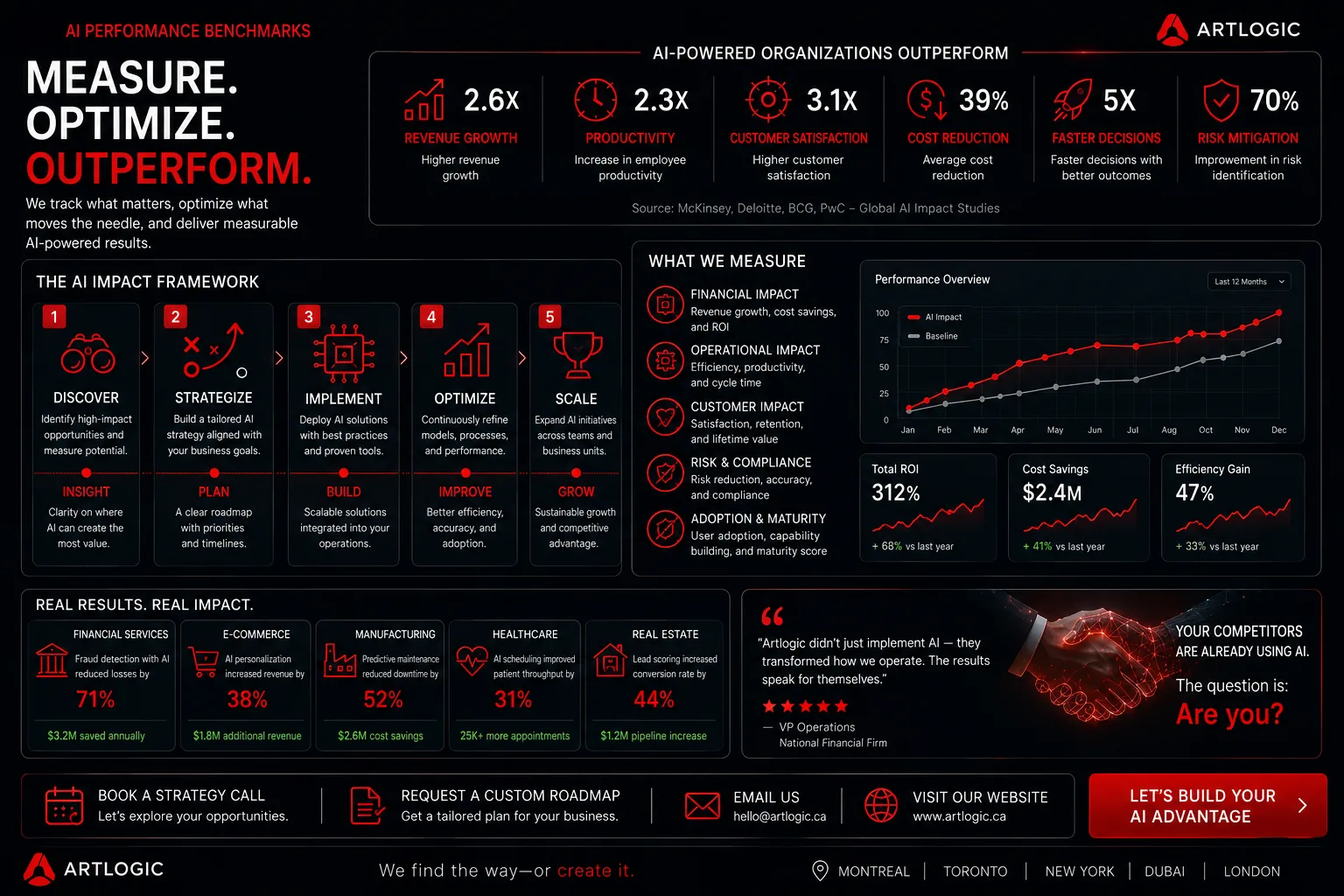
These aren't hypotheticals — they are the standard pattern for how AI implementation pays for itself: not through one large transformation project, but through several targeted, function-specific deployments that each pay back within months.
6. Generative AI
Generative AI refers to models trained to produce new content — text, images, audio, video, or code — based on a prompt. For business leaders, the relevant question isn't which model is "smartest" in the abstract; it's which model fits which job.
- ChatGPT (OpenAI) — broad general-purpose reasoning with a large ecosystem of integrations; commonly used for general drafting, brainstorming, and coding support.
- Claude (Anthropic) — strong reasoning on long documents and careful, reliable outputs, favored for business-critical and compliance-sensitive tasks like contract review, long-document analysis, and enterprise agents.
- Gemini (Google) — deep integration with Google Workspace and search; a natural fit for Docs- and Sheets-native workflows and search-grounded answers.
- Microsoft Copilot — native integration across Word, Excel, Outlook, and Teams; embedded productivity inside existing Microsoft 365 workflows.
- Perplexity — real-time web search with cited sources; used for research, competitive monitoring, and fact-checked answers.
- NotebookLM (Google) — source-grounded synthesis of uploaded documents; used for internal knowledge synthesis and research digestion.
Most mature organizations don't standardize on a single model — they route different tasks to different models based on cost, latency, and reasoning requirements, often through an AI gateway that abstracts the choice away from end users entirely. That routing layer is itself becoming a piece of core business infrastructure, the same way an email server or a CRM is.
7. AI Agents
An AI agent is a system that doesn't just answer a question — it takes a goal, breaks it into steps, uses tools like search, databases, APIs, and email to complete those steps, and acts, often without a human approving every individual step.
- Chatbot — answers questions in a single turn, with no memory and no tools.
- Assistant — holds context across a conversation and can call a few tools, but still waits for a human to initiate every request.
- Agent — given a goal, plans multiple steps, uses tools and data sources, executes a workflow end-to-end, and escalates edge cases to a human.
- Autonomous agent — operates continuously without being prompted, monitors for trigger conditions, and initiates action on its own.
A chatbot on a website answers "What are your hours?" An agent monitors the inbox, reads an inbound lead, checks CRM history, drafts a qualified response, schedules a follow-up call, and only escalates to a human when the conversation requires judgment a human should own — pricing exceptions, legal commitments, or an angry customer.
This is the layer of AI that produces the largest operational leverage, because it removes a human from the loop for the 80% of cases that are routine, while keeping a human firmly in control of the 20% that require it.
8. AI Automation
Automation is where generative AI and agents connect to the actual systems a business runs on — CRM, email, accounting software, contract repositories, and scheduling tools. Common automation pipelines include:
- Inbound lead → AI qualification → CRM update → sales notification.
- Email received → AI triage → draft reply → human approval → send.
- Invoice received → AI extraction → accounting entry → approval routing.
- Support ticket → AI categorization → knowledge-base answer → escalation if unresolved.
- Meeting held → AI transcript → summary and action items → CRM or project tool update.
The businesses that get the most value from automation don't try to automate everything at once. They pick one high-friction, high-volume workflow — usually something that currently eats hours of a skilled person's week and involves clear, repeatable rules — and automate that first, end to end, before moving to the next.
9. AI Marketing
Marketing is one of the functions where AI's return on investment is easiest to measure — and one of the areas seeing the fastest change in how work actually gets done.
- SEO — AI-assisted keyword research, content briefs, and technical audits that used to take an analyst days now take hours.
- GEO (Generative Engine Optimization) — structuring content so AI systems like ChatGPT, Claude, Gemini, and Perplexity can find, understand, and cite it — covered in depth below.
- Content strategy — AI drafts first passes of blog posts, case studies, and landing pages; human editors refine tone, accuracy, and brand voice.
- Email — personalized sequences generated and optimized per segment rather than one-size-fits-all blasts.
- Advertising — AI-driven audience targeting and creative testing that iterates faster than manual A/B testing cycles.
- Analytics — natural-language querying of marketing data instead of waiting on a dashboard build.
- Conversion optimization — AI-assisted testing of page layouts, copy, and offers.
- Personalization — dynamic content tailored to visitor behavior and firmographic data in real time.
- Predictive marketing — forecasting which segments and channels will produce the highest-quality pipeline before budget is spent.
The organizations pulling ahead here treat AI marketing not as "faster content production" but as faster iteration — more tests, more variants, more learning cycles per quarter than a human-only team could ever run.
10. Generative Engine Optimization (GEO)
This deserves its own chapter because it represents a genuine shift in how discovery works — and most companies haven't caught up to it yet.
Traditional SEO optimizes for one thing: ranking in a list of ten blue links on a search results page. GEO optimizes for being the source an AI system cites, quotes, or summarizes when it answers a question directly — inside ChatGPT, Claude, Gemini, Perplexity, or an AI Overview in Google itself.
The path from the open web to an AI answer runs through several retrieval layers — the traditional search index, each model's training data and browsing, and real-time answer engines with citations — and it ends in one of three outcomes for your brand: cited, quoted, or ignored. What determines the outcome:
- Structured data — Schema.org markup (Organization, Article, FAQ, HowTo) that makes your content machine-readable, not just human-readable.
- Entity SEO — being unambiguously identified as a specific entity — a company, a person, a service — across the web, not just ranking for keywords.
- Authority signals — consistent citation, backlinks, and mentions across authoritative sources, which AI systems weight heavily when deciding what to trust.
- Answer-first content structure — content organized so the direct answer to a likely question appears clearly, near the top, in a form that's easy to extract and quote.
- Knowledge graph presence — being represented in the structured knowledge bases that underlie search and AI retrieval, not just indexed as a web page.
- Freshness and specificity — AI systems increasingly favor content that is current, concrete, and backed by original data over generic, evergreen-but-vague copy.
The practical implication for executives: your website's job is no longer only to rank and convert human visitors. It is also to be legible to AI systems that may answer your prospective customer's question on your behalf, without them ever clicking through to your site at all.
Winning the citation is the new front page.
11. Risks of AI in Business
Adopting AI without understanding its failure modes is how organizations end up in the news for the wrong reasons. The risks are real, but every one of them is manageable with the right controls.
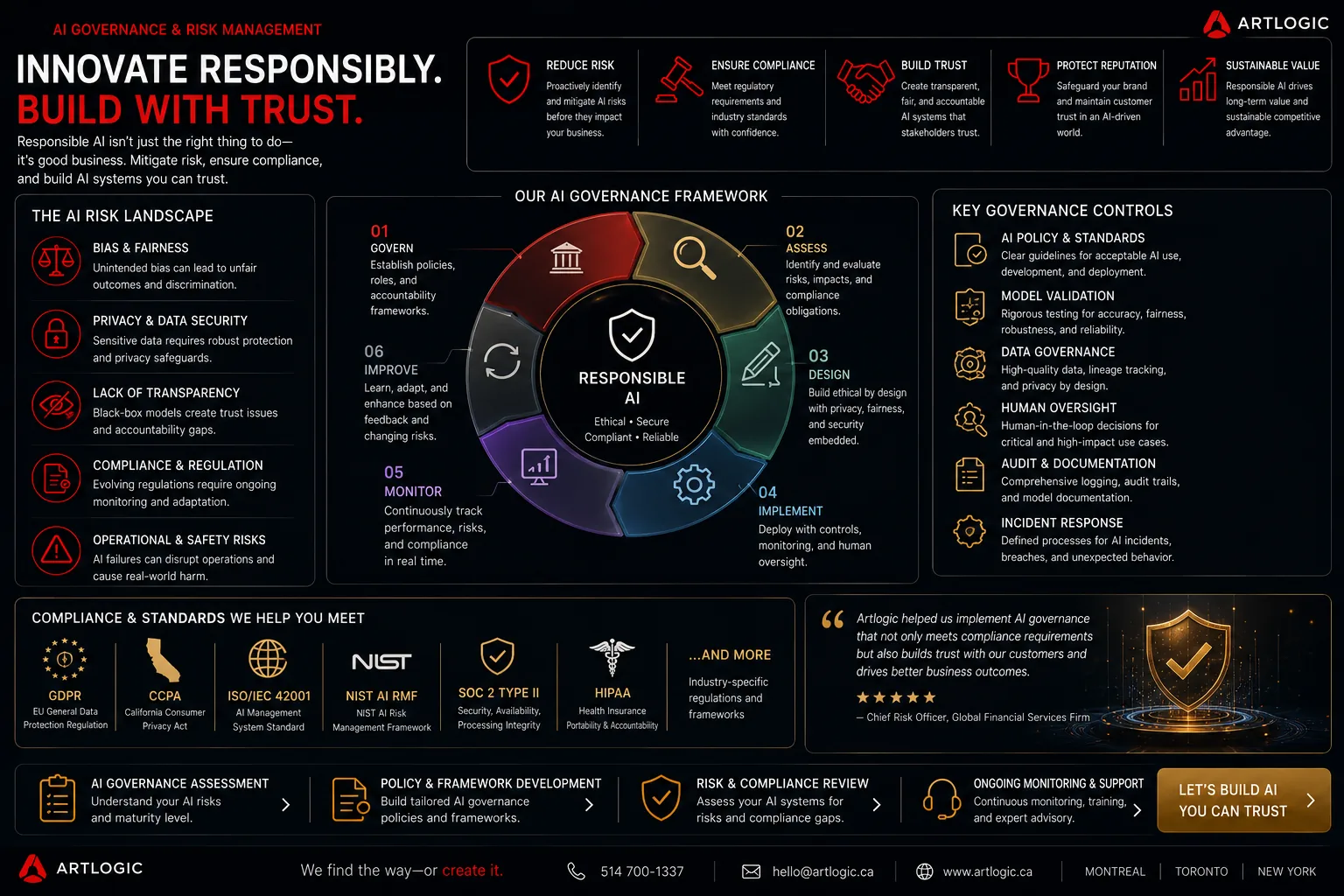
- Hallucinations — AI models can generate plausible-sounding but factually wrong output, especially on niche or outdated information. Any customer-facing or compliance-relevant output needs a verification step.
- Privacy — feeding customer or employee data into AI tools without clear data-handling agreements can create exposure under privacy regulations like GDPR, CCPA, HIPAA, and sector-specific rules.
- Security — AI systems introduce new attack surfaces — prompt injection, data exfiltration through tool access, and model manipulation — that traditional security tooling wasn't built to catch.
- Bias — models trained on historical data can reproduce historical bias, which is a real concern in hiring, lending, and any decision that affects people unequally.
- Copyright — the legal landscape around AI-generated content and training data is still evolving; organizations in regulated or IP-sensitive industries should track this closely.
- Governance — without clear ownership of who approves what AI does, organizations end up with shadow AI usage that nobody signed off on and nobody is monitoring.
- Compliance — regulated industries like healthcare, finance, and legal face sector-specific rules about automated decision-making that general-purpose AI tools weren't designed around.
None of these risks are a reason to avoid AI. They're a reason to implement it with a plan — which is the difference between organizations that adopt AI successfully and the ones that end up walking a deployment back after an incident.
12. AI Implementation Roadmap
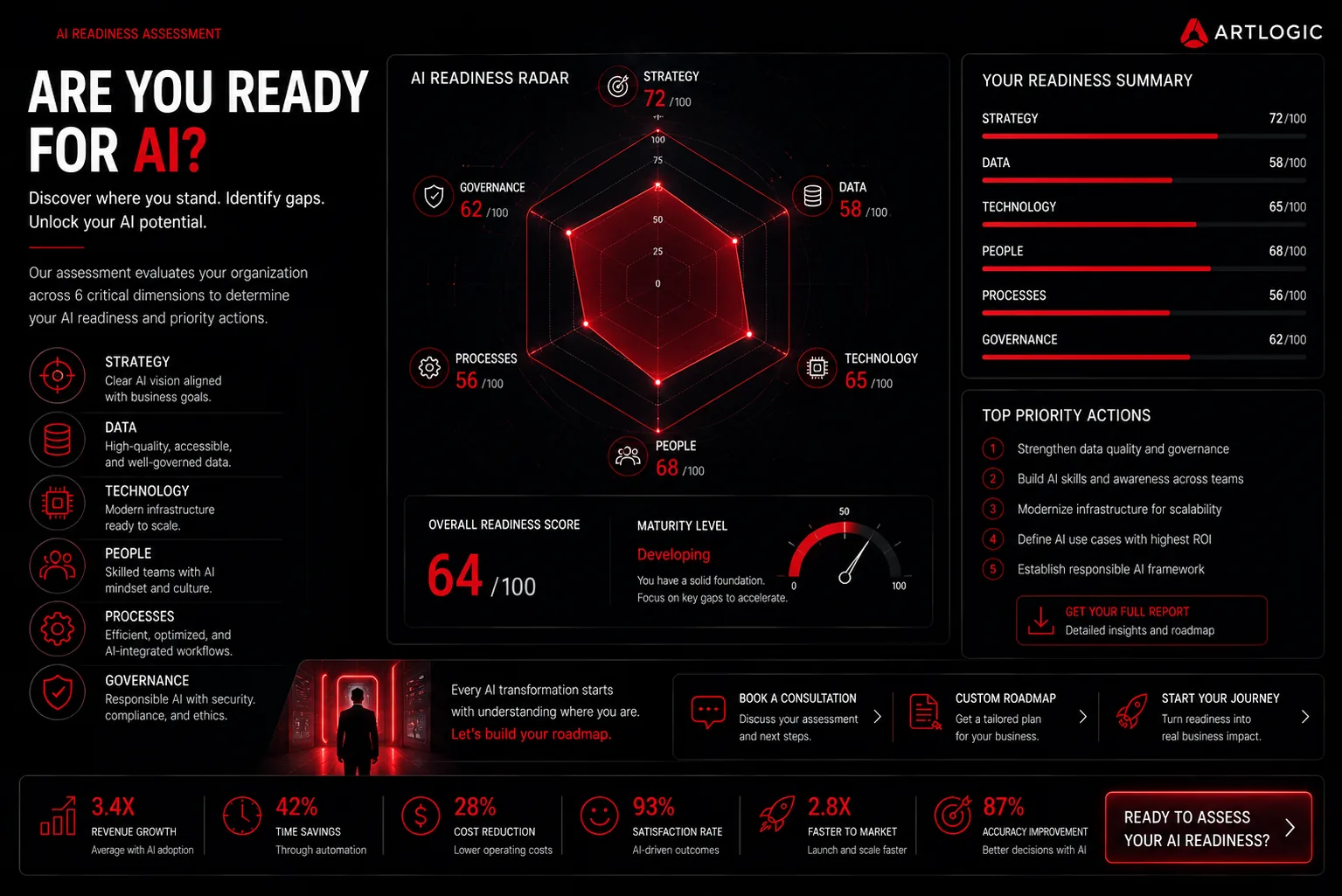
Every successful AI program starts with an honest readiness assessment — where your strategy, data, technology, people, processes, and governance actually stand today — and then moves through a staged rollout:
- Month 1 — Assessment: audit current workflows, identify the highest-friction repetitive tasks, map data sources, and establish a governance baseline.
- Month 2 — Pilot: deploy AI on one narrow, high-volume workflow with clear success metrics and a human-in-the-loop safety net.
- Month 3 — Automation: expand the pilot into a full automated workflow and connect it to core systems like CRM, email, and accounting.
- Month 4 — Integration: extend successful patterns to adjacent workflows and departments, and formalize governance and access controls.
- Month 5 — Optimization: tune models and prompts against real performance data, and retire manual fallback processes where AI has proven reliable.
- Continuous improvement — ongoing monitoring, retraining, expansion into new functions, and governance review as usage scales.
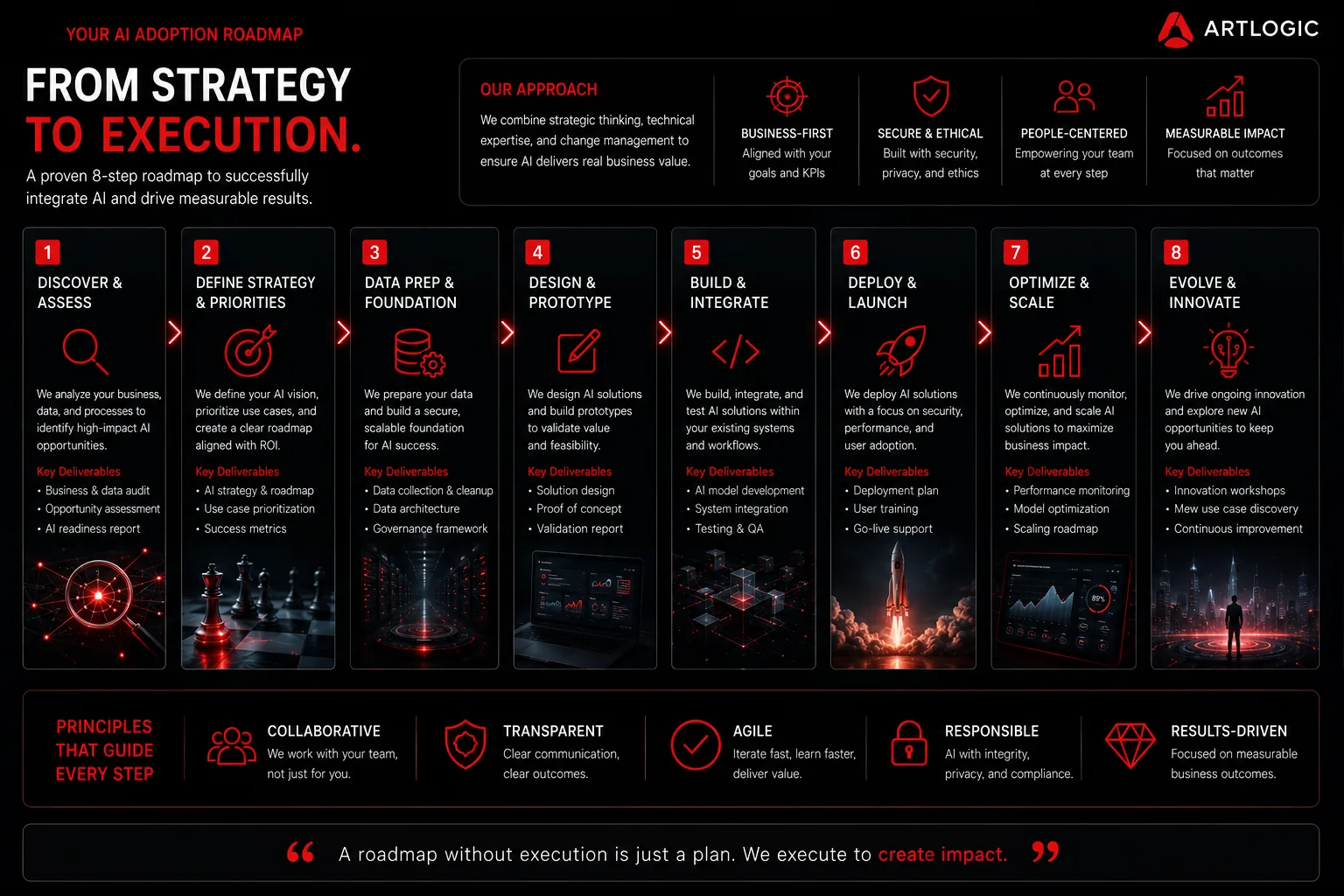
The single biggest predictor of success in this roadmap isn't the technology chosen in Month 1 — it's whether the organization picks a narrow, well-bounded, high-volume pilot instead of trying to automate an entire department at once. Narrow pilots get measurable wins in weeks. Broad transformation projects get stuck in committee.
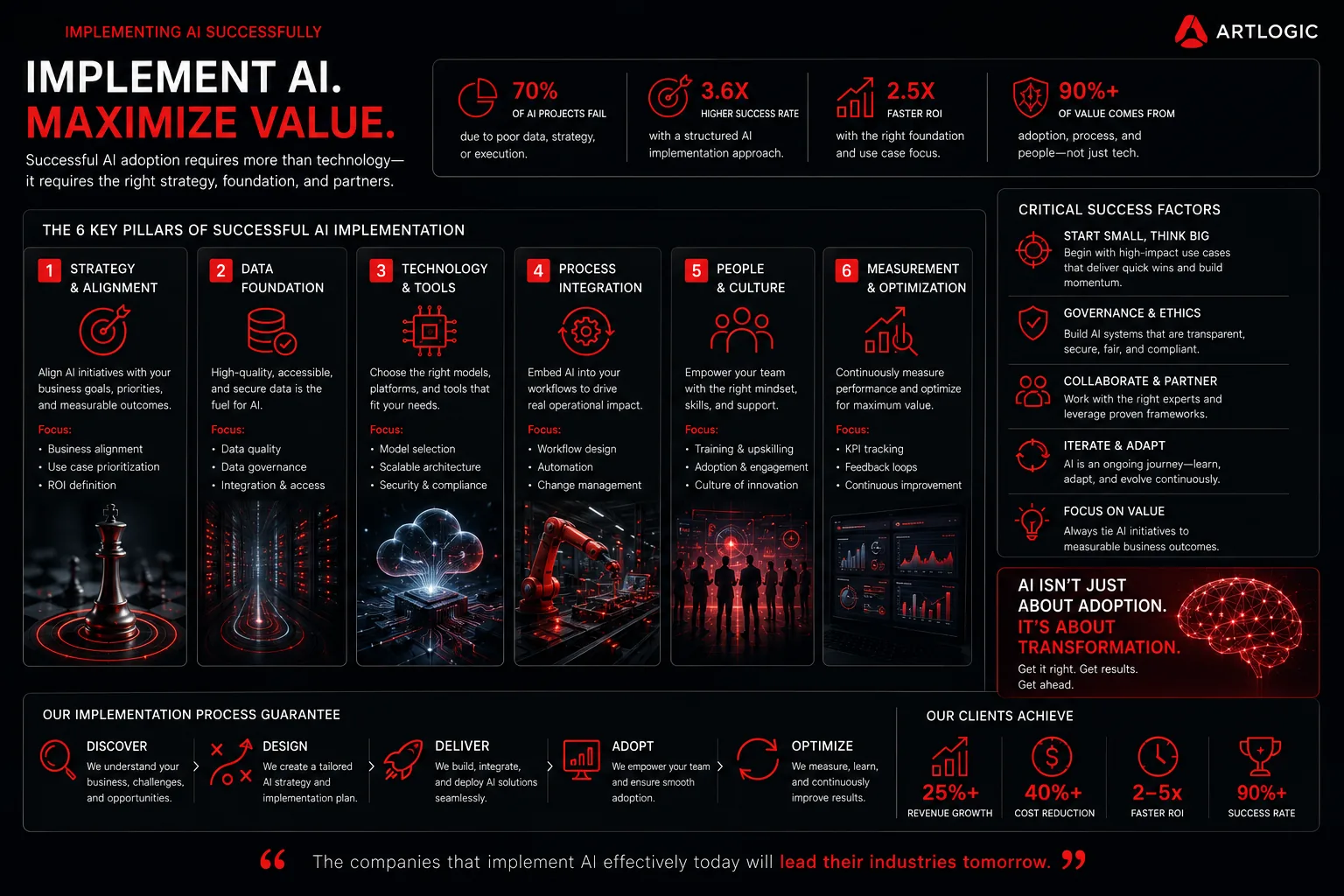
13. Industries Being Transformed by AI
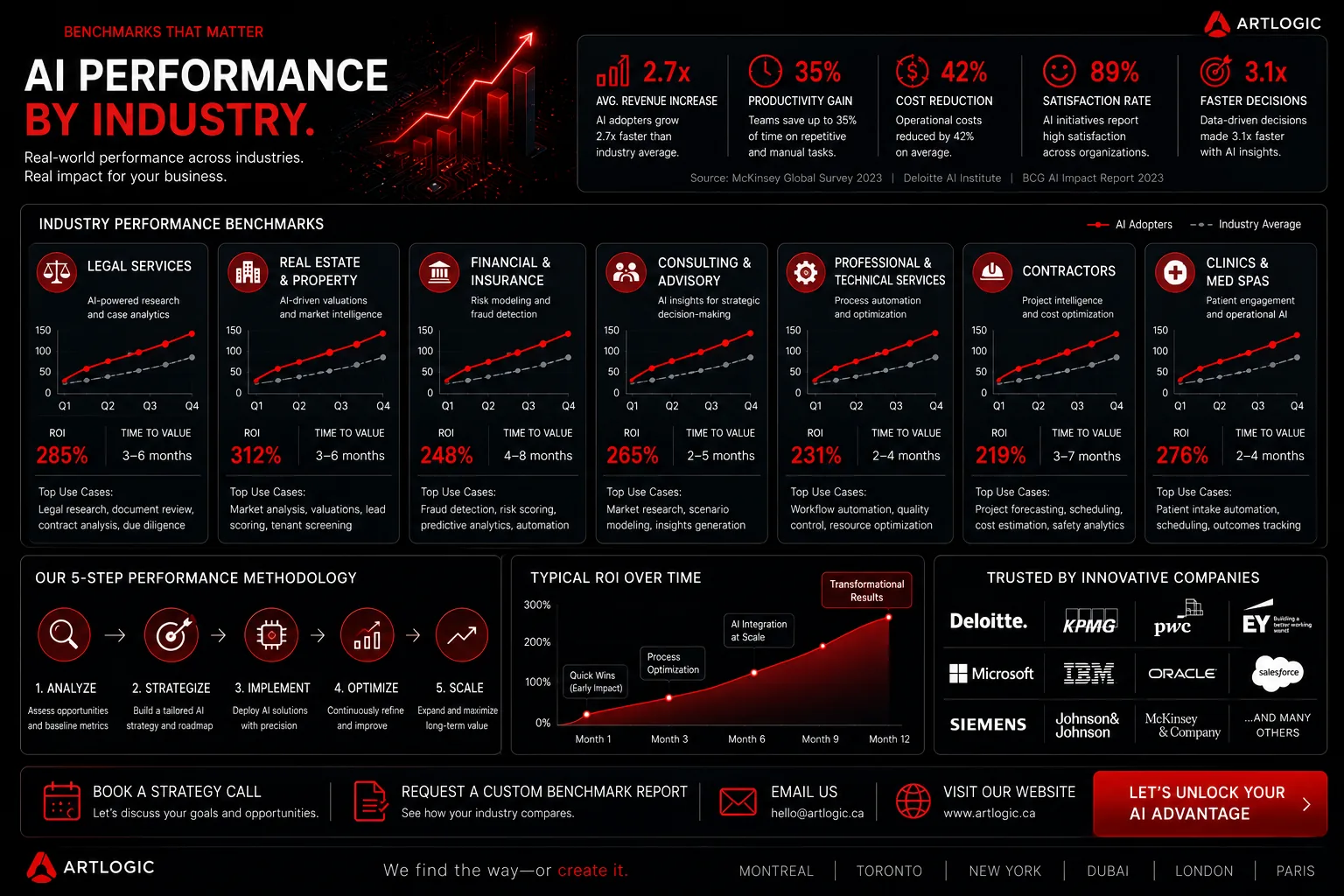
- Healthcare — clinical documentation, patient intake, claims processing, and diagnostic support are reducing administrative burden on clinical staff and shortening patient wait times.
- Legal — contract review, legal research, and intake automation are compressing work that used to require hours of associate time into minutes of review time.
- Finance — fraud detection, forecasting, and automated reporting are reshaping how finance teams close books and manage risk.
- Manufacturing — predictive maintenance and visual inspection are reducing downtime and defect rates on the production floor.
- Construction — scheduling optimization, safety monitoring, and automated bid generation are compressing project planning cycles.
- Retail — inventory forecasting, personalization, and AI-assisted customer service are reshaping margins on both the cost and revenue side.
- Real Estate — lead qualification, market analysis, and document processing are speeding up transactions in an industry historically bottlenecked by paperwork.
- Education — personalized learning and administrative automation are opening up instructor time for higher-value teaching.
- Professional Services — proposal drafting, research synthesis, and client reporting are compressing the billable-hour bottleneck that has defined the industry for decades.
Every one of these industries is at a different point on the adoption curve — but in each case, the organizations moving first are setting the operating benchmark the rest of the industry will eventually be measured against.
14. The Future of AI in Business
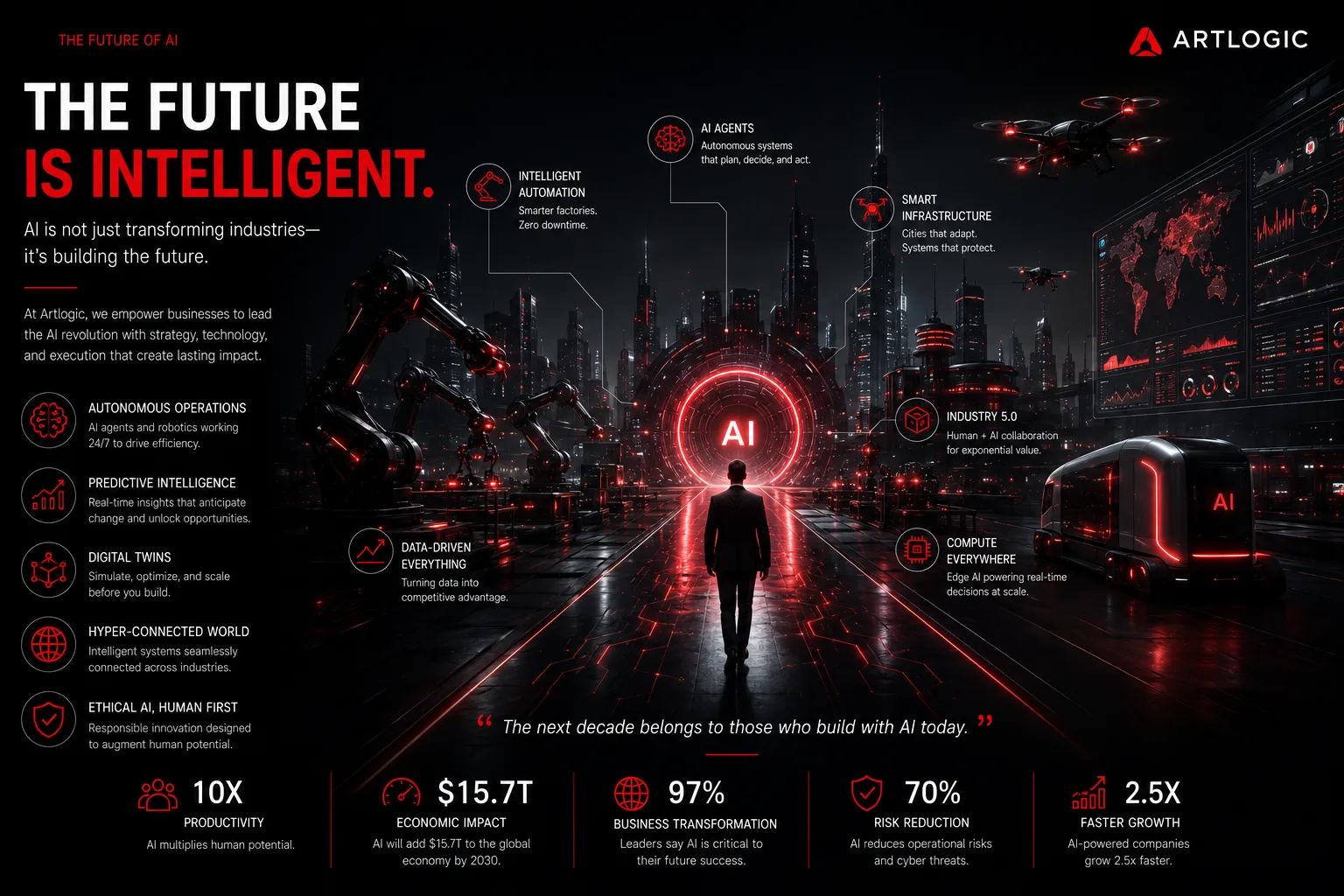
- AI agents will move from single-workflow automation to coordinating across entire departments, handing off work between specialized agents the way departments hand off work between human teams today.
- Robotics will increasingly pair with AI perception systems to bring the same automation gains to physical work that generative AI has brought to knowledge work.
- Autonomous organizations — a small human team overseeing a much larger footprint of AI-run workflows — will become a viable operating model for a meaningfully larger share of small and mid-sized businesses.
- AI search will continue displacing traditional search as the default way people find products, services, and information, accelerating the importance of GEO.
- Digital employees — persistent, named AI agents with defined roles, tools, and memory — will become a standard line item in how companies describe their team, not a novelty.
- Multimodal AI — systems that reason across text, images, audio, and video simultaneously — will unlock use cases like site inspections, medical imaging, and video content analysis that text-only AI can't touch today.
None of this is speculative science fiction — every trend above is already visible in production systems today. The only open question is the pace of diffusion into the average business, and that pace has consistently been faster than expected at every stage of this technology's development so far.
Explore The Technologies Defining The Next Decade Of AI
The future of artificial intelligence will be shaped by several interconnected technologies. Each represents a major shift in how organizations operate, compete, and create value.
AI Agents
The digital workforce that perceives, decides, and acts across your systems — the execution layer of the autonomous business.
Read Full GuideAI Robotics
Intelligence in motion: computer vision and autonomous machines bringing AI's reasoning to physical work.
Read Full GuideAutonomous Organizations
The operating model where a small human team directs a large AI workforce — human-led, AI-executed.
Read Full GuideAI Search & GEO
The new rules of digital visibility — becoming the answer AI systems trust, cite, and recommend.
Read Full GuideDigital Employees
AI workers with defined roles, memory, and KPIs — a fourth workforce category alongside your team.
Read Full GuideMultimodal AI
Beyond language: AI that reasons across text, images, audio, video, and sensors to understand reality.
Read Full GuideRecursive Self-Improvement
The idea that a system could improve its own ability to improve — what is demonstrated, and what is still speculation.
Read Full GuideHow Artlogic Helps
Artlogic works with CEOs, founders, and operating leaders to move from "we should look into AI" to a working, measurable AI deployment — without the multi-year transformation program.
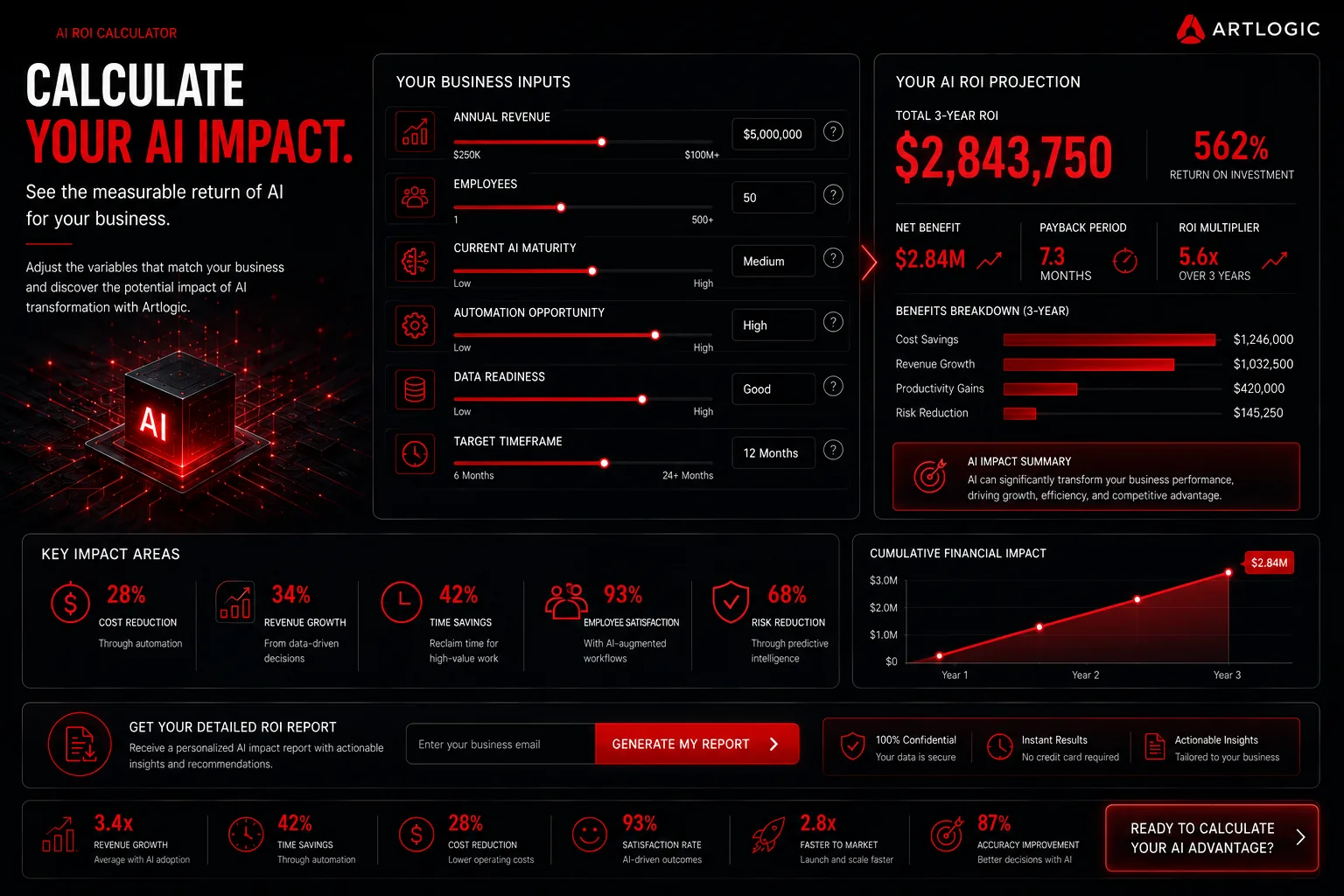
That work spans the full arc of an AI transformation — artificial intelligence consulting, AI transformation services, generative AI consulting, AI automation and business process automation, digital transformation, and CRM automation — alongside the growth engine that compounds it: marketing management, growth and performance marketing, SEO, and generative engine optimization (GEO).