Part of our Artificial Intelligence in Business series — a complete executive guide to putting AI to work across your organization.
Search Has Changed Forever
For more than two decades, digital visibility followed a relatively predictable model. A user entered a query into Google. Google returned a list of links. The user clicked a website. The website provided the answer.
GEO is one pillar of a much broader shift covered in our guide to artificial intelligence in business — the same forces reshaping operations, sales, and support are now reshaping how customers discover you.
This process became the foundation of modern SEO, content marketing, digital advertising, and online customer acquisition.
Today, that model is beginning to change.
Artificial Intelligence is transforming how people discover information, evaluate businesses, and make decisions.
Instead of searching for links, users increasingly ask questions directly to AI systems such as ChatGPT, Claude, Perplexity, Gemini, and other AI-powered search platforms.
They are no longer searching for websites. They are searching for answers.
This shift is creating an entirely new discipline known as Generative Engine Optimization (GEO) — the practice of improving how businesses, brands, products, and expertise are discovered, understood, referenced, and recommended by AI systems.
Organizations that understand GEO today will gain a significant advantage in the next generation of digital visibility.
Those that rely exclusively on traditional SEO may discover that rankings alone are no longer enough.
Why Search Is Changing
Search has never remained static. Every major technological shift has changed how people find information.
The progression has been remarkably consistent: Directories → Search Engines → Google → Mobile Search → Voice Search → AI Search → Personal AI Assistants.
Each stage reduced friction. Each stage moved users closer to immediate answers. AI search represents the next step in that evolution.
Users Want Answers, Not Websites
Historically, users accepted the process of clicking through multiple pages to find information. Today, expectations are different. People increasingly expect instant answers, personalized responses, context-aware recommendations, and direct guidance.
AI systems satisfy those expectations. Instead of reviewing ten search results, users can simply ask which law firm is best for commercial litigation in Montreal, which CRM platform suits a manufacturing company, or which digital marketing agency specializes in AI visibility. The AI synthesizes information and provides recommendations immediately.
AI Assistants Are Becoming Discovery Engines
Platforms such as ChatGPT, Claude, Perplexity, and Gemini are increasingly acting as discovery platforms. Users ask these systems which software they should buy, which company they should hire, which solution is best, and which provider is most trusted.
This transforms visibility from a ranking problem into a recommendation problem. The brands that AI understands and trusts gain visibility. The brands it does not understand disappear.
The Decline of Blue-Link Dominance
Google's traditional blue links are not disappearing overnight. However, their role is evolving. The future of search is increasingly conversational, contextual, personalized, and AI-mediated. Visibility is moving from search results toward AI-generated answers. That shift changes everything.
Google vs AI Search
Understanding the difference between traditional search and AI search is critical.
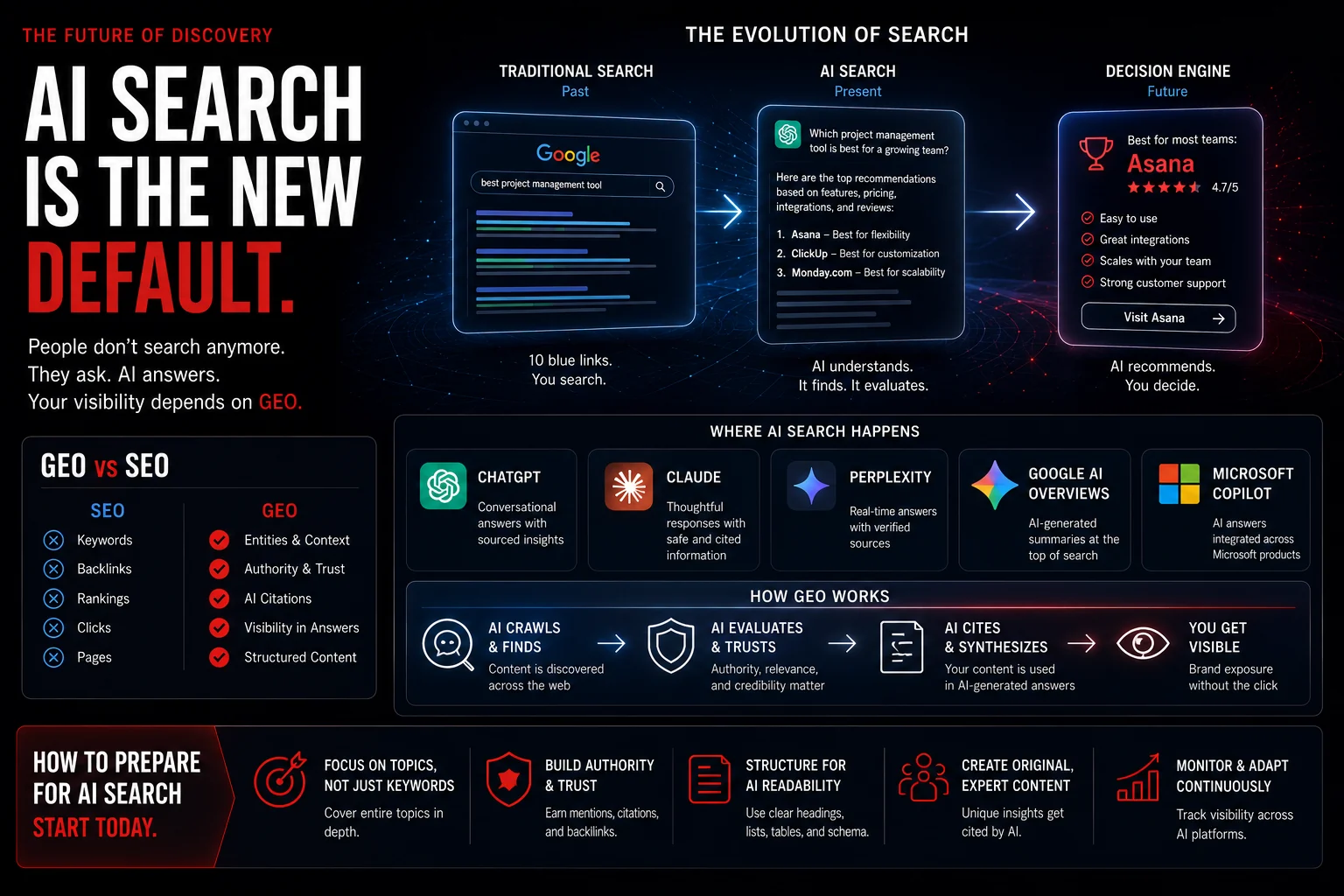
In traditional search, the user searches, the engine returns links, the user clicks websites, the user compares information, and the user finds the answer. Google's primary objective is to rank pages. The user performs the synthesis.
In AI search, the user asks a question, the AI retrieves information, the AI evaluates sources, the AI synthesizes findings, the AI cites sources, and the AI provides an answer. The AI performs the synthesis.
The fundamental difference is simple. Google ranks pages. AI ranks knowledge. Google asks users to determine which source is best. AI increasingly makes that determination on behalf of users.
This means businesses must optimize not only for rankings but also for credibility, authority, and machine understanding. The question is no longer whether you can rank. The question becomes whether AI will trust you enough to recommend you.
How ChatGPT Finds Information
One of the most common questions businesses ask is how ChatGPT decides what companies, products, or sources to recommend. The answer is more complex than traditional search. ChatGPT is not a conventional search engine. Instead, it combines multiple layers of intelligence.
For an autonomous organization, GEO is not a marketing tactic — it is how the company stays discoverable in a market increasingly mediated by AI.
Large language models learn patterns from enormous collections of information, creating foundational understanding of industries, concepts, organizations, products, and relationships. When available, ChatGPT can access current web information to supplement existing knowledge, improving freshness and accuracy.
Entities are one of the most important concepts in AI visibility. An entity is a clearly identifiable thing, such as a company, brand, person, product, or location. The stronger your entity presence, the easier it becomes for AI systems to understand who you are and what you do.
AI systems also evaluate authority signals that suggest expertise and credibility, such as expert content, trusted publications, industry references, professional recognition, and consistent information. Brands that are frequently discussed across authoritative sources become easier for AI systems to identify and trust. Machines prefer structured information they can clearly understand, and knowledge graphs help connect entities and relationships.
ChatGPT does not simply retrieve pages. It synthesizes information from multiple signals to generate recommendations.
How Perplexity Finds Information
Perplexity represents one of the clearest examples of AI-native search. Unlike traditional search engines, Perplexity emphasizes real-time retrieval and citations.
Perplexity searches for information first and generates answers second. This retrieval-first approach prioritizes source discovery and evidence. Fresh information is a major component of the platform, making recent content, current events, and updated information particularly important.
One of Perplexity's defining characteristics is transparency. Users can review sources directly, so businesses that earn citations increase their visibility. Perplexity evaluates relevance, authority, credibility, and freshness before incorporating sources into answers, and not all sources are treated equally. Trusted sources generally carry greater influence, which reinforces the importance of authority-building strategies.
In Perplexity's ecosystem, citations matter immensely.
How Claude Finds Information
Claude approaches information differently from traditional search systems. Rather than focusing solely on retrieval, Claude excels at contextual understanding and long-form reasoning.
Claude is designed to analyze information within broader context. Rather than treating facts as isolated points, it evaluates relationships and meaning. Claude performs exceptionally well when processing large amounts of information, which makes comprehensive, authoritative content particularly valuable. It often combines insights from multiple sources and concepts to create cohesive responses, and rather than evaluating only popularity, it emphasizes coherence, credibility, and contextual relevance.
As AI adoption expands inside organizations, systems like Claude increasingly influence research, procurement, vendor evaluation, and strategic planning. Businesses must consider visibility not only in consumer search environments but also within enterprise AI workflows.
GEO vs Traditional SEO
This is where the future of digital visibility becomes clear.
The primary goal of SEO is simple: rank pages. Success is measured by rankings, traffic, clicks, and sessions. SEO focuses heavily on keywords, backlinks, technical optimization, and search intent.
Generative Engine Optimization focuses on a different objective. The goal is not simply to rank. The goal is to become the answer. Success is measured by AI visibility, AI citations, brand recommendations, entity recognition, and authority signals.
SEO focuses on keywords, links, rankings, and traffic. GEO focuses on authority, trust, citations, entities, knowledge graphs, and AI visibility.
SEO remains important. GEO builds on top of SEO. The future belongs to organizations that excel at both.
GEO Ranking Factors
This may be the most important section for organizations preparing for AI search. While ranking mechanisms differ across systems, several themes consistently emerge.
Entity recognition asks whether AI can clearly identify who you are, what you do, where you operate, and why you matter. Strong entities are easier to recommend.
Authority remains one of the most important ranking factors, with signals including expertise, industry recognition, high-quality content, and trusted references. AI systems learn from conversations occurring across the web, so brands discussed frequently and positively gain visibility.
Machines understand structured information more effectively than unstructured information. Organizations that demonstrate deep expertise across an entire subject area gain trust, because topic ecosystems matter more than any single article. Content created from genuine expertise consistently outperforms generic content.
AI systems increasingly rely on references, so the more credible sources mention your business, the stronger your visibility becomes. Independent validation through reviews provides additional trust signals. And consistency across websites, directories, profiles, and publications strengthens visibility, because conflicting information creates confusion.
The future of ranking is not about manipulating algorithms. It is about building genuine authority.
How Businesses Can Prepare
Organizations that begin preparing today will be better positioned as AI search adoption accelerates.
Build authority by becoming known for something specific. Create expert content that demonstrates genuine knowledge, because depth matters. Implement structured data to help machines understand your content. Improve brand mentions to earn visibility beyond your own website. Earn citations, because authority is reinforced when others reference your expertise. Optimize your knowledge graph presence to ensure your business is clearly connected to relevant entities and topics. Invest in GEO as a strategic initiative. And monitor AI visibility by regularly assessing AI recommendations, AI citations, brand visibility, and entity strength.
Preparation today creates visibility tomorrow.
The Future of Search
The future of search may not look like search at all.
As AI agents begin making purchasing recommendations on behalf of users, being the answer an agent trusts becomes a direct revenue channel — not just a marketing metric.
People increasingly begin their journey with AI assistants. Future systems will understand individual preferences, goals, and context. AI agents may increasingly make purchasing recommendations on behalf of users. Transactions will occur directly within AI conversations. Product discovery will become increasingly recommendation-driven. Future AI systems will reason across text, images, audio, and video simultaneously. Voice interactions will continue growing as AI improves.
The most profound shift may be the gradual disappearance of traditional search experiences. Users will simply ask. AI will answer. Visibility will depend on whether your business becomes part of that answer.
The GEO Strategy Framework
Organizations need a systematic approach to AI visibility.
It starts with an audit to assess current digital presence, followed by a visibility assessment to measure AI discoverability, authority mapping to identify authority gaps, a content strategy to develop comprehensive topic ecosystems, a citation strategy to increase trusted mentions and references, GEO implementation to optimize content, entities, structured data, and authority signals, measurement to track visibility across AI platforms, and continuous optimization, because AI ecosystems evolve constantly.
The Artlogic GEO framework runs from Foundation to Authority to Content to Entities to Citations to AI Visibility. Organizations that master these layers position themselves to thrive in the next generation of search.
Conclusion
Search is entering a new era. Artificial Intelligence is transforming how people discover information, evaluate businesses, and make decisions.
Traditional SEO remains essential, but rankings alone are no longer enough. The organizations that succeed in the coming years will not simply optimize for search engines. They will optimize for intelligence engines.
Generative Engine Optimization represents the evolution of digital visibility from ranking pages to becoming trusted answers. The future belongs to businesses that are discoverable, understandable, credible, and recommendable by AI systems.
As AI search continues to expand, the question is no longer whether GEO matters. The question is whether your competitors will implement it before you do.