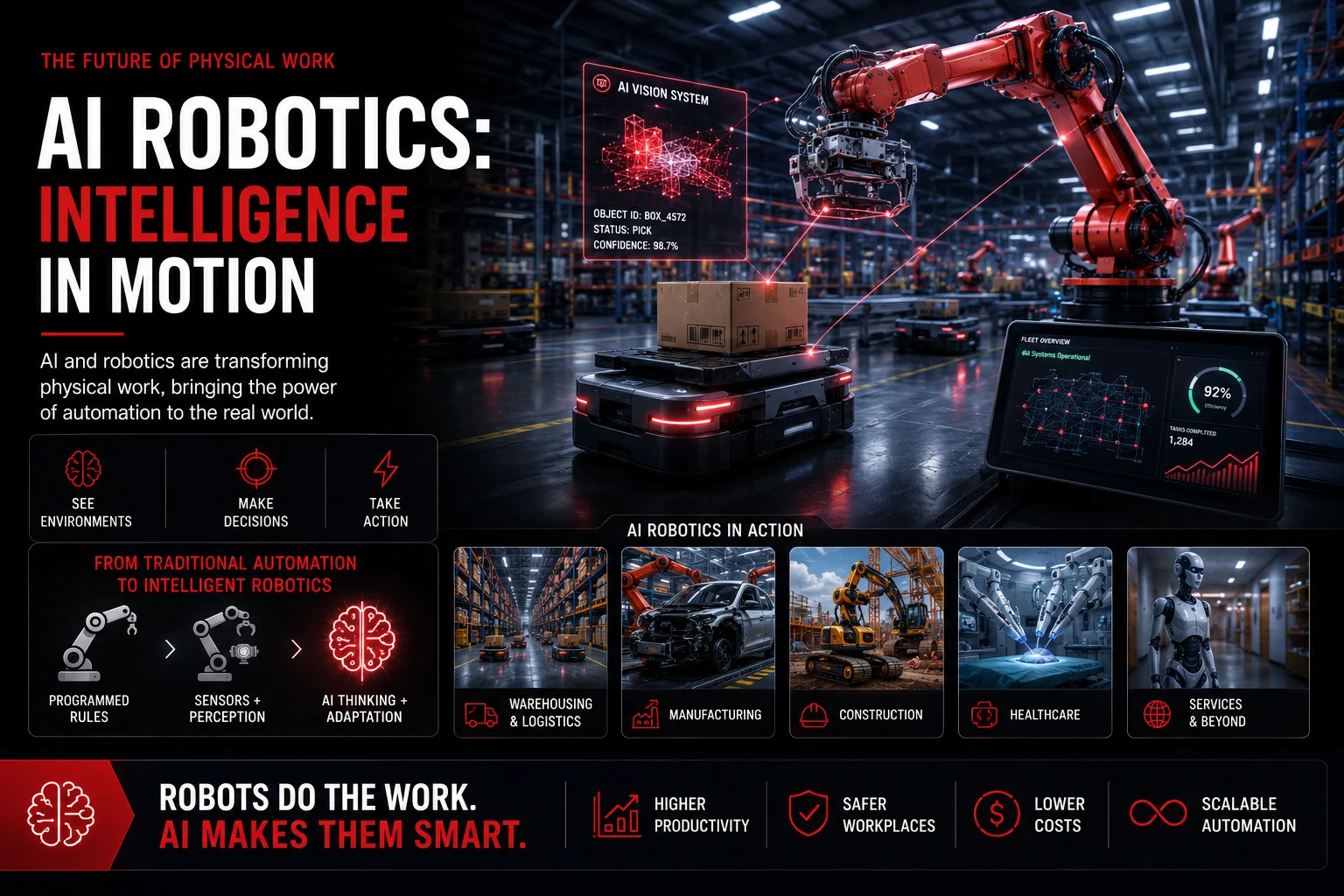
Part of our Artificial Intelligence in Business series — a complete executive guide to putting AI to work across your organization.
AI Is Bringing Intelligence Into the Physical World
For decades, robots have been a cornerstone of industrial automation. They weld vehicles, package products, assemble electronics, and perform repetitive tasks with incredible precision.
Yet most traditional robots have always suffered from one major limitation: they are only capable of doing exactly what they were programmed to do.
If the environment changes, the object moves, the process evolves, or an unexpected event occurs, traditional automation often breaks down.
Artificial Intelligence is changing that.
Just as Generative AI transformed knowledge work by enabling software to reason, understand, and create, AI robotics is bringing those same capabilities into the physical world. Robots are becoming more adaptable, more autonomous, and more capable of working alongside humans in dynamic environments.
The convergence of robotics, machine learning, computer vision, sensors, and AI-powered decision-making is creating a new generation of intelligent machines capable of perceiving their surroundings, making decisions, and taking actions without constant human guidance.
From smart factories and autonomous warehouses to construction sites, hospitals, and logistics networks, AI robotics is redefining what automation means.
Organizations that embrace this transformation will unlock new levels of productivity, efficiency, safety, and scalability.
Why Robotics Is Entering Its AI Era
Industrial robots are not new. Manufacturers have been using robotic arms and automated machinery for decades.
Traditional robotics helped automate repetitive tasks such as welding, assembly, packaging, material handling, painting, and sorting.
These systems revolutionized industrial production, but they were limited by their rigidity. Traditional robots operate according to predefined instructions. If a part arrives in the wrong position, a conveyor changes speed, or a new product configuration is introduced, the robot often requires reprogramming.
This rigidity limits adaptability.
Artificial Intelligence changes everything. By combining robotics with machine learning, computer vision, sensor fusion, and advanced reasoning systems, robots can now recognize objects, understand environments, adapt to changing conditions, learn from experience, optimize performance, and collaborate with humans.
The result is a shift from automation to autonomy.
Robots are evolving from machines that follow instructions into systems capable of understanding goals and determining how to achieve them.
This marks the beginning of the AI era in robotics.
Traditional Automation vs Intelligent Robotics
Not all automation is intelligent. Understanding the difference between traditional automation and AI-powered robotics is essential.
Traditional Automation
Traditional robots excel in structured environments. Characteristics include fixed programming, predictable workflows, limited adaptability, minimal environmental awareness, and no learning capabilities.
These systems perform exceptionally well when conditions remain constant. However, they struggle when faced with uncertainty.
Intelligent Robotics
AI-powered robots operate differently. They can interpret sensor data, understand context, recognize patterns, adapt behavior, learn from outcomes, and make decisions.
Instead of following a fixed path, intelligent robots continuously evaluate their surroundings and adjust their actions.
Imagine two warehouse robots. The first follows a predefined route. The second uses AI to avoid obstacles, reroute around congestion, prioritize urgent deliveries, and optimize travel time.
The second robot is not simply automated. It is intelligent.
As AI capabilities continue advancing, intelligent robotics will increasingly outperform traditional automation in complex environments.
Computer Vision and Robotics: Giving Machines Eyes
One of the most important breakthroughs in AI robotics is computer vision. If robotics provides movement, computer vision provides perception.
This visual perception is one expression of multimodal AI — the same capability that lets AI reason across images, audio, and sensor data at once, and the bridge between a robot's reasoning and its physical action.
Computer vision enables machines to interpret and understand visual information from cameras and sensors. In many ways, it functions as the robot's eyes.
Object Detection
AI systems can identify products, components, tools, people, vehicles, and defects. This capability allows robots to work with greater flexibility than traditional systems.
Quality Control
Manufacturers increasingly use AI-powered vision systems to inspect products. These systems can identify defects that would be difficult or impossible for humans to detect consistently. Benefits include higher quality standards, reduced waste, faster inspections, and improved consistency.
Spatial Awareness
Modern robots can build a real-time understanding of their surroundings. This allows them to navigate dynamic environments, avoid collisions, coordinate with humans, and adapt to changing layouts.
Autonomous Navigation
Computer vision is a key component of autonomous mobile robots, warehouse vehicles, delivery robots, and industrial transportation systems.
Without vision, robots are blind. With AI-powered vision, robots become aware.
AI in Warehousing
Warehousing is one of the industries being transformed most rapidly by AI robotics. As consumer expectations for faster delivery continue to rise, companies require more efficient logistics systems.
Picking Robots
Modern robots can identify, select, and transport products throughout fulfillment centers, improving speed, accuracy, and productivity.
Intelligent Sorting Systems
AI can dynamically sort packages based on destination, priority, delivery method, and capacity constraints.
Inventory Management
AI-powered robots continuously monitor inventory levels and warehouse conditions, enabling better forecasting, reduced stockouts, and improved inventory accuracy.
Autonomous Forklifts
Self-driving forklifts are beginning to replace traditional material handling processes. These systems can transport goods, avoid obstacles, optimize routes, and operate continuously.
Last-Mile Logistics
The future may include autonomous delivery vehicles, delivery robots, and drone-assisted logistics.
Warehouse automation is evolving into a fully connected ecosystem of intelligent machines.
AI in Manufacturing
Manufacturing remains one of the largest opportunities for AI robotics. Factories are evolving into intelligent production environments where machines continuously monitor, optimize, and improve operations.
Predictive Maintenance
Rather than waiting for equipment to fail, AI systems can predict maintenance needs before breakdowns occur, reducing downtime, lowering maintenance costs, and increasing equipment lifespan.
Production Optimization
AI analyzes production data to identify opportunities for improvement, increasing throughput, efficiency, and resource utilization.
Quality Assurance
AI-powered inspection systems continuously monitor production quality. Defects can be identified instantly rather than after production is complete.
Intelligent Production Lines
Future production lines will coordinate humans, robots, and AI systems simultaneously. The result is a more adaptive and resilient manufacturing environment. This transformation is often referred to as the rise of the Smart Factory.
AI in Construction
Construction has historically lagged behind other industries in adopting digital technologies. AI robotics is beginning to change that.
Site Monitoring
Computer vision systems can monitor construction sites in real time, identifying safety violations, equipment utilization, progress updates, and potential risks.
Autonomous Equipment
Heavy machinery is becoming increasingly autonomous, including excavators, bulldozers, haul trucks, and site vehicles.
Progress Tracking
AI systems compare site conditions against project plans to track completion status automatically, improving visibility and accountability.
Safety Systems
Construction remains one of the most dangerous industries. AI-powered monitoring systems can identify unsafe behavior, restricted zone violations, and hazardous conditions.
The result is safer and more efficient project execution.
AI in Healthcare
Healthcare represents one of the most impactful applications of AI robotics. Rather than replacing medical professionals, intelligent robotics enhances precision, efficiency, and patient outcomes.
Surgical Robotics
Advanced robotic systems assist surgeons during complex procedures, enabling greater precision, smaller incisions, faster recovery, and reduced complications.
Diagnostics
AI-powered imaging systems assist in analyzing X-rays, CT scans, MRI images, and ultrasounds. These systems help clinicians identify patterns more quickly.
Patient Monitoring
AI systems continuously monitor patient conditions and alert healthcare professionals when intervention may be required.
Rehabilitation Robotics
Robotic devices support patients recovering from injuries or neurological conditions. Personalized therapy programs can improve outcomes while reducing strain on healthcare staff.
Healthcare robotics demonstrates how AI can augment human expertise rather than replace it.
Humanoid Robots: The Next Frontier
Perhaps no area of robotics captures public imagination more than humanoid robots. Companies such as Tesla Optimus, Figure AI, Agility Robotics, and Sanctuary AI are developing robots designed to operate in environments built for humans.
Unlike traditional industrial robots, humanoid robots can walk, carry objects, manipulate tools, navigate buildings, and interact with people.
Potential Benefits
Humanoid robots may help address labor shortages, repetitive work, dangerous tasks, and workforce scalability.
Challenges
Significant challenges remain, including reliability, safety, energy efficiency, cost, dexterity, and regulatory considerations.
What Comes Next?
While widespread deployment is still developing, many experts believe humanoid robots will become increasingly common across warehousing, manufacturing, healthcare, retail, and logistics.
The coming decade may determine whether humanoid robotics becomes one of the largest technological shifts since the industrial revolution.
The Future of Physical Automation
The future is not robots replacing humans. The future is humans and intelligent machines working together.
As physical and digital automation converge, they point toward the same destination: the autonomous organization, where AI coordinates both knowledge work and physical operations under human direction.
Human and Robot Collaboration
Collaborative robots, often called cobots, are designed to work safely alongside people. Rather than replacing workers, they enhance productivity and reduce repetitive workloads.
Autonomous Facilities
Factories, warehouses, and logistics centers will increasingly operate with minimal human intervention. AI systems will coordinate equipment, inventory, transportation, maintenance, and production.
Smart Factories
The smart factory combines robotics, AI, sensors, IoT devices, and analytics to create self-optimizing production environments.
AI-Native Operations
Future organizations will integrate AI into every operational layer. Decision-making, execution, monitoring, and optimization will become increasingly automated.
Physical work will become more intelligent. Operations will become more adaptive. Organizations will become more resilient.
Conclusion
AI robotics is bringing intelligence into the physical world. By combining robotics, computer vision, machine learning, and autonomous decision-making, organizations can achieve levels of productivity, efficiency, and scalability that were previously impossible.
From warehouses and factories to hospitals and construction sites, intelligent robots are transforming how physical work gets done.
The companies that embrace AI robotics today will gain a significant competitive advantage tomorrow.
The future of automation is no longer about machines following instructions. It is about intelligent systems understanding objectives, adapting to change, and working alongside humans to achieve extraordinary outcomes.
The age of AI-powered physical work has begun.